

The astronomer Copernicus, who lived in the 16th century, realized that Earth was a planet. Before that, the universe was thought to be much smaller. It was believed to consist of the Earth and stars suspended above, the nature of which is unknown. Since then, it has been discovered that, in addition to the other planets in the Solar System, there are other planets orbiting other stars. It has become clear that Earth is not the center of the universe. Not everything revolves around us, as once thought. Our planet is one of the planets orbiting the Sun, one of billions of stars in billions of galaxies. But all this doesn’t make it a “worthless” planet. On the contrary, there aren’t many habitable planets like Earth. At least, there’s nothing similar nearby in our system.
Earth is the third planet closest to the Sun. Therefore, it could be said to be at the most suitable distance for living things to survive. The surfaces of Mercury and Venus, which are closer to the Sun, are too hot to support life. In contrast, Mars is too cold. Because the other planets are mostly composed of gas, they don’t even have surfaces suitable for living. Because Pluto is so small, some consider it a planet.
He doesn’t even see it as such. There are other reasons why Venus and Mars are uninhabitable. Venus is over-radiated due to its very thick atmosphere. In contrast, Mars freezes over due to its very thin atmosphere.
Today, we know a lot about our planet. Studies conducted on Earth, in the oceans, and in space have provided a wealth of information about Earth. However, one fact we understand is that, unlike the other planets in the Solar System, Earth is a “living” planet. While Earth has a rocky structure, it is composed of many layers. Each layer has its own characteristics. The “crust” we live on is the thinnest of these layers. The crust is approximately 40 km thick. The crust is composed largely of silicon compounds. The layers beneath the crust, called the upper and lower mantle, are the thickest. Their total thickness reaches 2,700 km and consists mostly of silicon compounds, oxygen, calcium, and aluminum. Unlike the crust, the mantle is not solid; it is liquid. Beneath the mantle lies the outer core. Like the mantle, this layer is liquid and contains, among other elements, iron and nickel. The core, however, is mostly composed of iron and nickel and is solid. The core is even hotter than the Sun’s surface.
Unlike other planets, our planet’s crust is mobile. The thin crust, composed of six large plates and numerous smaller pieces, “floats” on the liquid mantle. The plates move relative to each other. As they do so, some sections of the plates collide with each other, while others rub against each other. Some plates move away from each other. This leads to various consequences. This movement is one of the main reasons why the Earth has a “living” structure. This movement causes earthquakes and combustion.
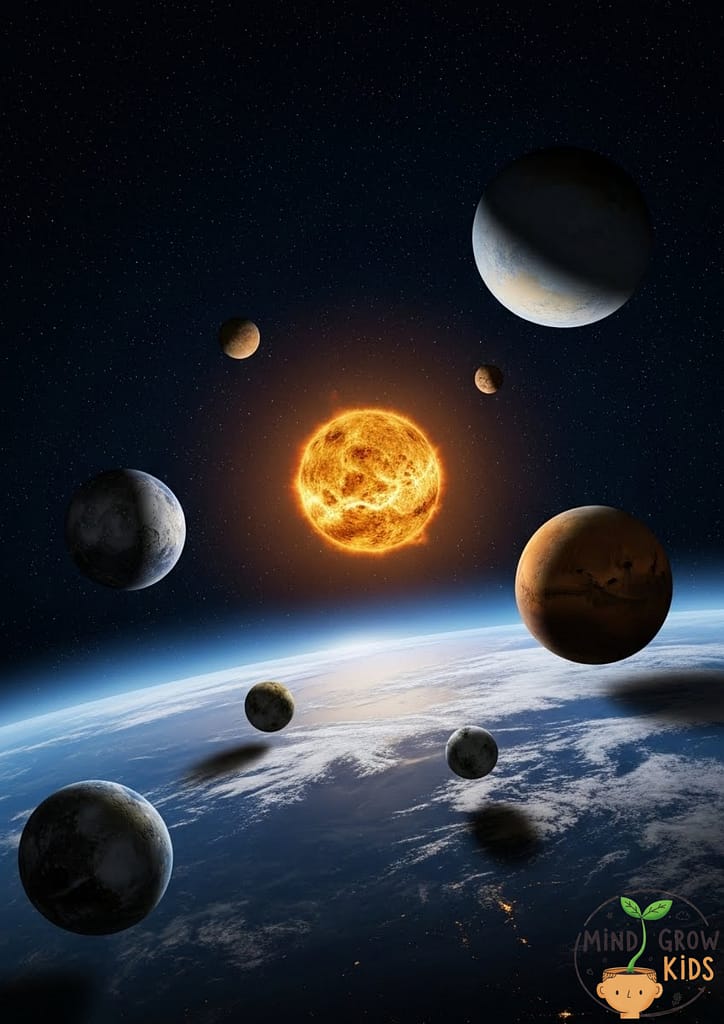
Mountains erupt, mountain ranges form. Due to plate movements, continents shift over long periods of time. Atmospheric events also have significant effects on the Earth. The Earth is constantly reshaped by the effects of rain and wind. The other rocky planets in the Solar System have cooled significantly, leaving their surfaces “dead.” The most obvious evidence of this is the impact craters found on their surfaces, dating back billions of years. Our planet must have experienced similar impacts in the past. However, surface changes have largely obliterated these traces. Earth also distinguishes itself from other planets by the presence of liquid water on its surface. Water, a fundamental requirement for life, covers 71% of our planet. Liquid water has not been found on other planets in the solar system. However, it is thought that liquid water may exist beneath the frozen outer crust of Saturn’s moon Titan and Jupiter’s moon Europa. Earth’s atmosphere consists of 77% nitrogen, 21% oxygen, and small amounts of argon, carbon dioxide, and water vapor. Carbon dioxide creates a greenhouse effect, causing the planet’s temperature to rise. If carbon dioxide were not present in the atmosphere, the average surface temperature of 14°C would be -21°C. This means that life as we know it cannot exist on Earth. However, rising carbon dioxide levels also cause problems. Even a few degrees of surface temperature increase endangers the survival of many species. Global warming, one of today’s most significant problems, occurs because we release too much carbon dioxide into the atmosphere.
Sources:
http://seds.lpl.arizona.edu/nineplanets/earth.html
http://www.solarviews.com/eng/earth.htm