

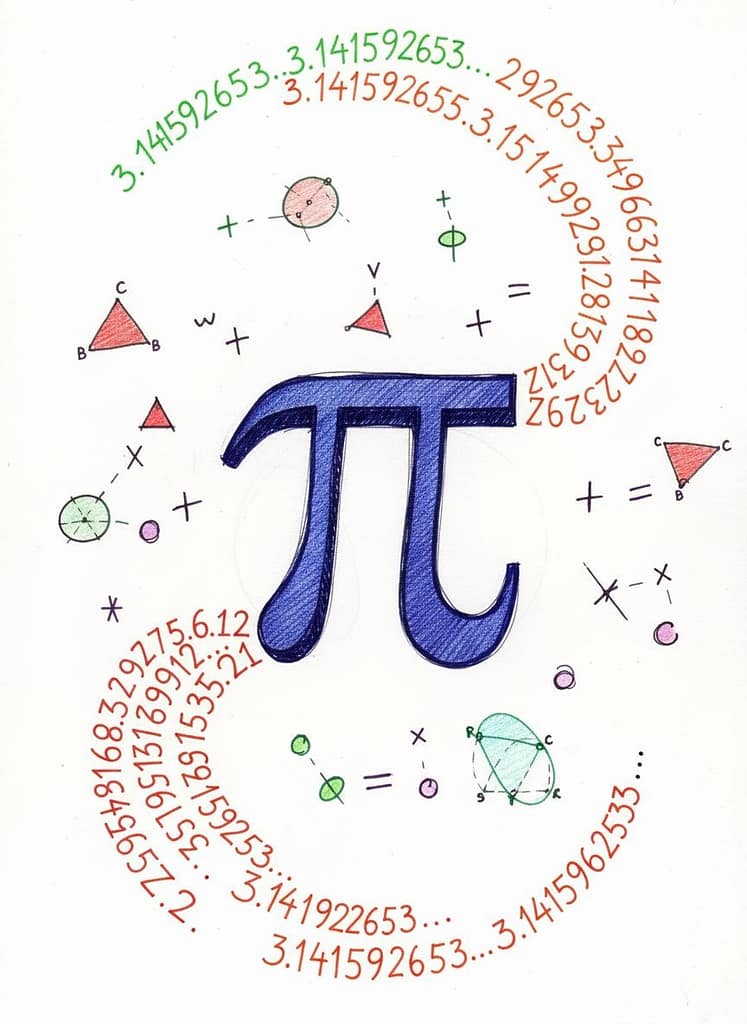
We want to introduce you to a very, very special number. This number, called “Pi,” means a great deal to a mathematician. Pi is used to calculate the area and volume of circular objects. Without Pi, for example, we wouldn’t know how many cubic meters of water a swimming pool will hold before filling it. Pi appears in many areas, from how planets move to how many beads can fit into a cylindrical box. Pi has an infinite number of digits. Here you see the first 100 digits of Pi.
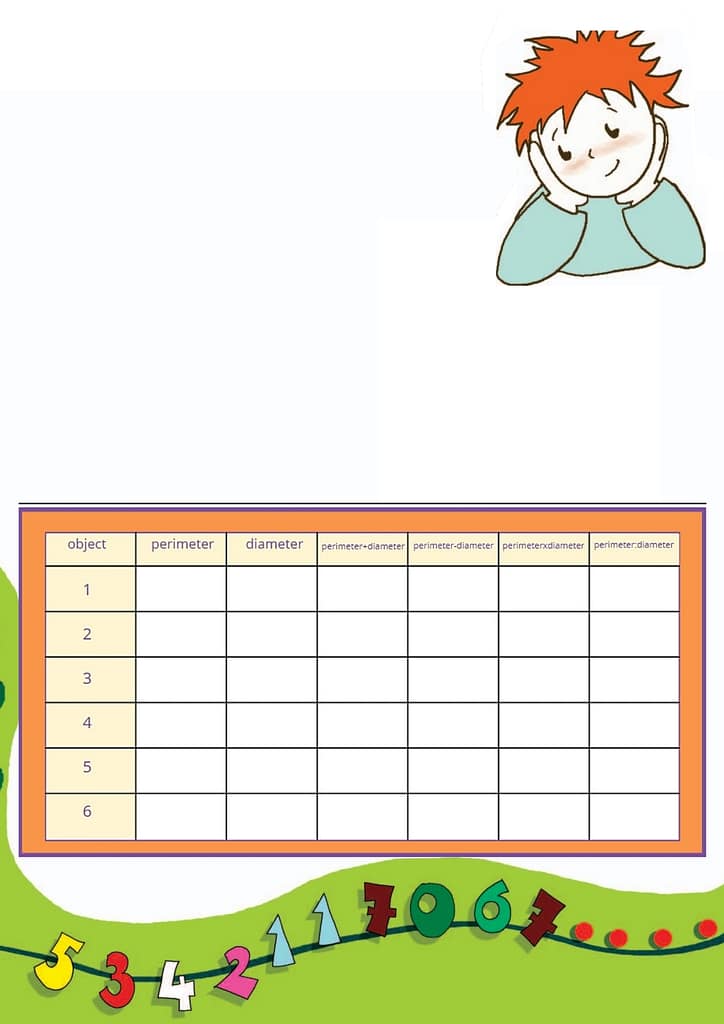
Are you ready to explore the number Pi together? You’ll need a pen, paper, string, tape measure, and ruler. Choose six circular objects. For example, a table, tray, plate, CD, etc. Measure the circumference of these circles using the string and ruler and record it in the table below. Now, measure the diameter of the objects and record it in the table as well. Then, perform the calculations indicated in the table using these circumference and diameter values. Write the results in the appropriate places in the table. You can use a calculator if needed during these calculations. After filling in all the blanks, carefully examine the table. Is there anything interesting that you find?
Object 1 2 3 4 5 6 Circumference Diameter The “Circumference :
Diameter” values in the last column are very close to the values of the number pi we mentioned above, aren’t they? Thanks to your measurements and calculations, you too have rediscovered this interesting number. Pi is the number obtained by dividing the circumference of a circle by its diameter. This division gives the same numerical value for every circular shape. Therefore, the number pi is considered a “mathematical constant”. The symbol for pi, π, is a Greek letter and the first letter of the Greek word for “circumference”.
The number pi, also known as the “Archimedes constant,” is often associated with the buoyancy of water. Archimedes lived between 287 and 212 BC and was the first scientist to state that pi is equal to 22/7.
You Can Turn the Number Pi into a Necklace!
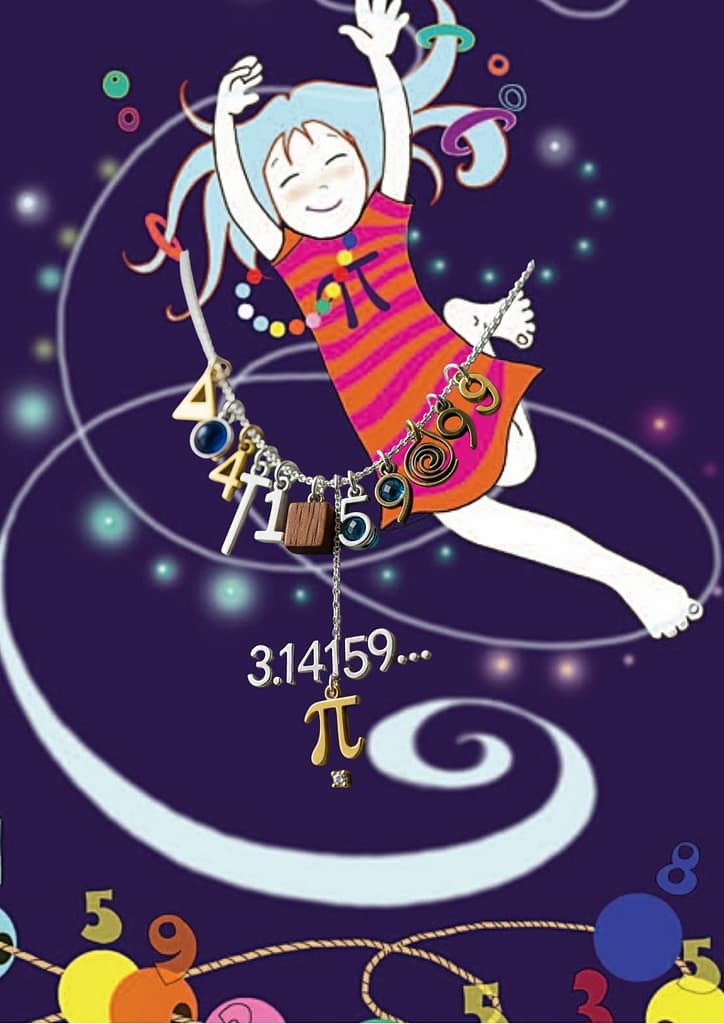
We previously mentioned that the number Pi consists of an infinite number of digits. Imagine each digit is represented by a different colored bead. You can then arrange these beads to create a necklace, following the sequence of the first 100 digits of Pi. For example, let’s take the first 6 digits of Pi (3.14159…). Let’s say we decide to use a red bead for 3, a blue bead for 1, a white bead for 4, a yellow bead for 5, and an orange bead for 9. Then, the first 6 beads of our Pi necklace would be red, blue, white, blue, yellow, and orange.
When is Pi Day?
Throughout history, the number pi has fascinated many people. Because of this interest, a special day has been designated for it: March 14th, celebrated worldwide as Pi Day. But why March 14th? The first digit of pi, 3, represents the month of March, and the following digit, 14, represents the day of the week, hence the 14th of March is celebrated as Pi Day. Pi Day has been celebrated since 1988. Some even celebrate Pi Day at 1:59 AM on March 14th. March 14th, the day Pi Day is celebrated, is also Albert Einstein’s birthday. Many events related to the number pi are held around the world on Pi Day. Many competitions are also held on this day. For example, one of these competitions involves reciting the digits of pi. In 2002, Esther Dennis set a world record by reciting 5401 digits of pi from memory. Another competition is eating the most “pi cakes” in 3 minutes and 14 seconds. Another requires contestants to name circular objects within 2 minutes. A very similar competition involves saying names that begin with the syllable “pi”. For example, Picasso, pizza, piano, pilot. Pi is such a beloved and intriguing number that there are organizations around the world such as the Pi Lovers Club and the Pi Friends Association. We wish you days filled with “Plenty of Pi”!
Sources:
http://web.archive.org/web/20041011060212/witcombe.sbc.edu/earthmysteries/EMPi.html http://www.educationworld.com/a_lesson/lesson/lesson335.shtml http://www.mathwithmrherte.com/pi_day.htm http://web.archive.org/web/20050305084755/http://archive.ncsa.uiuc.edu/