

The circumference of the Earth was measured a very, very long time ago — in the 3rd century BC. How do you think they might have done it back then?”
About 2,250 years ago, Alexandria in northern Egypt was one of the most important centers of knowledge in the ancient world. The mathematicians, astronomers, and thinkers of the time often visited the great library in the city. Eratosthenes, the head librarian, would read and think a lot in the library.
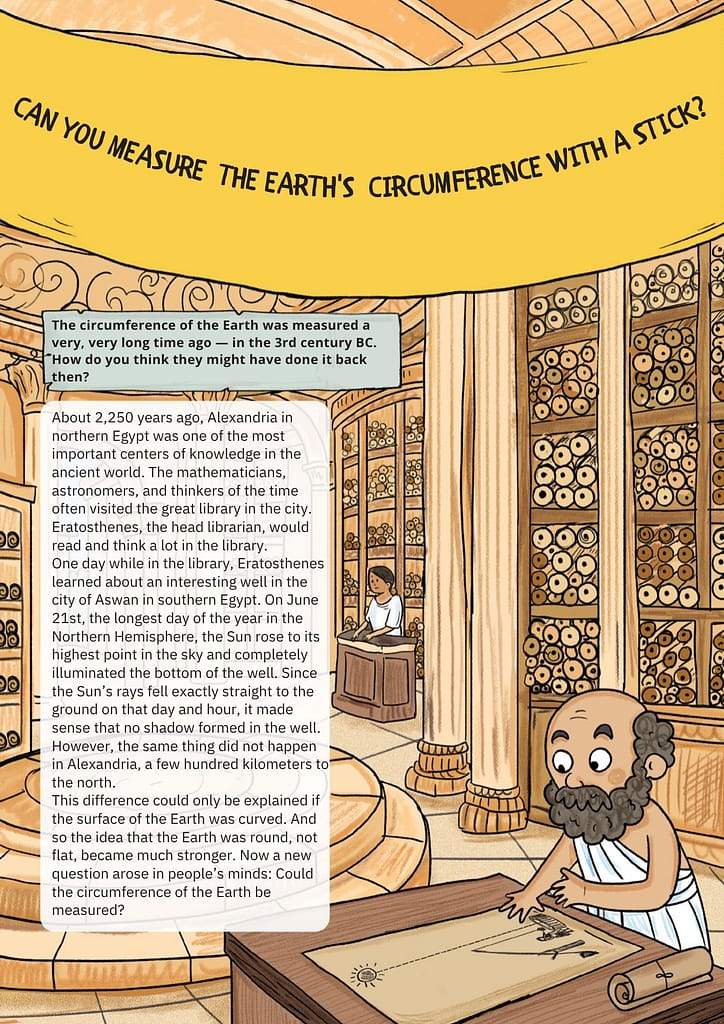
One day while in the library, Eratosthenes learned about an interesting well in the city of Aswan in southern Egypt. On June 21st, the longest day of the year in the Northern Hemisphere, the Sun rose to its highest point in the sky and completely illuminated the bottom of the well. Since the Sun’s rays fell exactly straight to the ground on that day and hour, it made sense that no shadow formed in the well. However, the same thing did not happen in Alexandria, a few hundred kilometers to the north.
This difference could only be explained if the surface of the Earth was curved. And so the idea that the Earth was round, not flat, became much stronger. Now a new question arose in people’s minds: Could the circumference of the Earth be measured?”
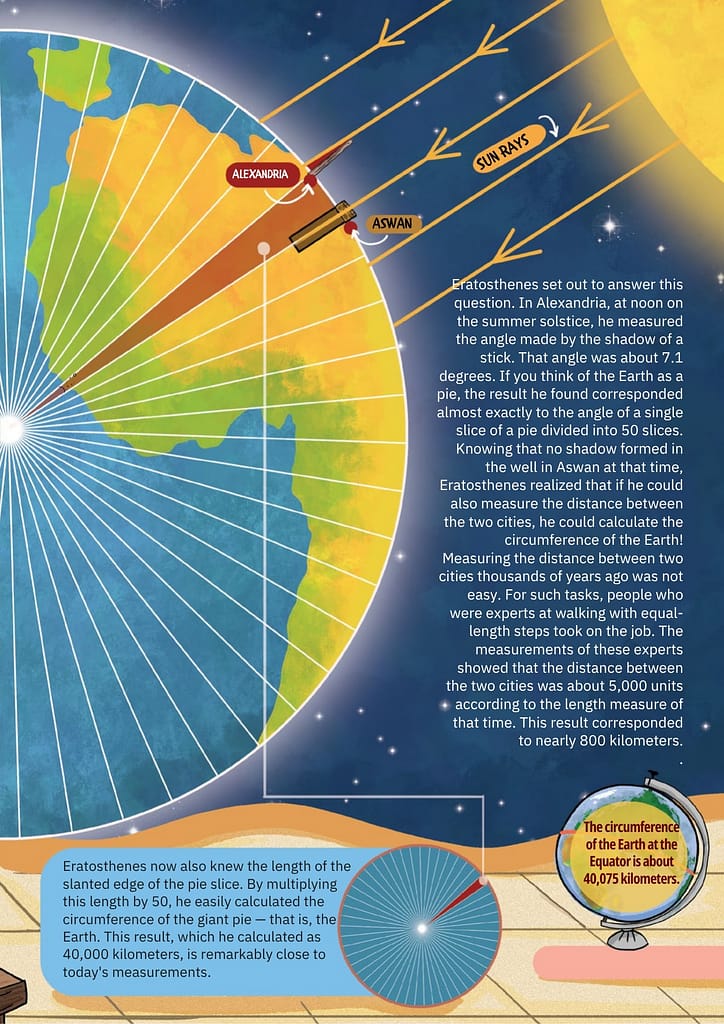
Eratosthenes set out to answer this question. In Alexandria, at noon on the summer solstice, he measured the angle made by the shadow of a stick. That angle was about 7.1 degrees. If you think of the Earth as a pie, the result he found corresponded almost exactly to the angle of a single slice of a pie divided into 50 slices.
Knowing that no shadow formed in the well in Aswan at that time, Eratosthenes realized that if he could also measure the distance between the two cities, he could calculate the circumference of the Earth!
Measuring the distance between two cities thousands of years ago was not easy. For such tasks, people who were experts at walking with equal-length steps took on the job. The measurements of these experts showed that the distance between the two cities was about 5,000 units according to the length measure of that time. This result corresponded to nearly 800 kilometers.
Eratosthenes now also knew the length of the slanted edge of the pie slice. By multiplying this length by 50, he easily calculated the circumference of the giant pie — that is, the Earth. This result, which he calculated as 40,000 kilometers, is remarkably close to today’s measurements.