
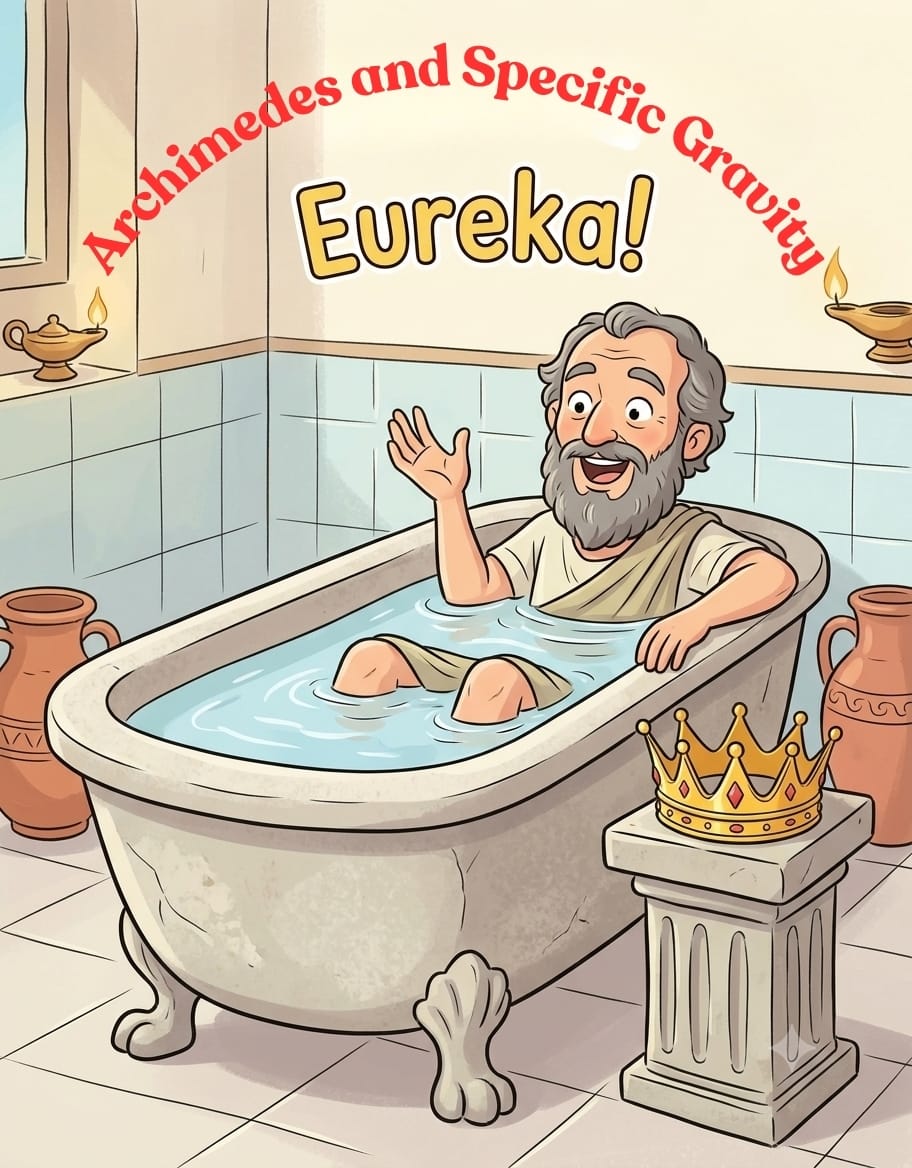
Archimedes and Specific Gravity…
Archimedes (Archimed), who lived in the 3rd century B.C., was a good engineer and physicist as well as a good mathematician. Inventions such as the Archimedes Screw (Coctilias), which is still used in Egypt to raise the waters of the Nile for irrigation purposes, the hydrostatic law also known as Archimedes’ Principle, and the catapult belong to him. When Archimedes rushed out of the bath naked, shouting “Eureka, eureka!” (“I found it!”), what he actually found was not the buoyancy of water; he had discovered that much earlier.
To understand what Archimedes found, one must know what he was thinking about that day. Hiero, the King of Syracuse at that time, had a crown made of pure gold. When he suspected whether the goldsmith who made the crown had used all the gold he received from him, he assigned his close friend Archimedes to solve this problem. Could the goldsmith have replaced some of the gold with a less valuable metal like silver or copper and kept that amount for himself?
That day, when Archimedes stepped into the bathtub filled with water, he realized that the volume of the overflowing water was equal to the volume of the submerged part of his body. This meant that he could measure the volume of the crown, which did not have a geometric shape, in the same way by placing the crown in a vessel filled with water.
If we explain how Archimedes solved the crown riddle using our current knowledge: If we assume the gold ingot King Hiero gave to the goldsmith was in the shape of a cube weighing 746 grams with sides of 4.9 cm , we can calculate that the volume of this cube is approximately $118\text{ cm}^3$. If the goldsmith had made the crown entirely of gold, the crown would still weigh 746 grams and its volume would be $118\text{ cm}^3$, even though its shape was different. However, if the goldsmith made the crown using gold and silver half-and-half, then even if the crown weighed 746 grams, its volume would change. Since the specific gravity of gold is $19.3\text{ g/cm}^3$ and that of silver is $10.5\text{ g/cm}^3$ , the volume of a 746-gram crown made by mixing gold and silver half-and-half should be $167\text{ cm}^3$.
Archimedes used the volume comparison method he found by chance to understand whether King Hiero’s crown was made of pure gold, threw the crown into the water, and measured the volume of the overflowing water. The result of the measurement not only revealed the goldsmith’s fraud but also led to the discovery of specific gravity…
The Native American Remedy for Malaria: Quinine… Among several legends about the discovery of quinine, the most effective substance used in the treatment of malaria, the most common one is about how the Countess of Chinchon, the wife of the Governor of Peru, recovered from malaria. When the Countess of Chinchon recovered from malaria with a medicine obtained from the bark of a tree found in Peru, she brought this bark with her when returning to Spain in 1638. Inspired by this story, the famous Swedish botanist Linnaeus named this tree genus “Cinchona” (cinchona) in 1742, whose bark was used to make medicine for malaria treatment.
The oldest known record regarding quinine dates back to 1630 in Lima, the capital of Peru. It concerns the use of this medicine by Jesuit missionaries in the treatment of malaria. Although not certain, it is thought that the missionaries learned to use quinine in malaria treatment from Native Americans. According to a legend, the healing properties of the cinchona tree bark were discovered completely by chance.
A Native American burning with malaria fever gets lost in the forests of the Andes Mountains. While struggling to survive, he comes across a pond surrounded by cinchona trees. However, the quinine found in the roots of the cinchona trees, which Native Americans had considered poisonous until then, had mixed into the waters of this pond. The Native American cannot withstand his thirst and, risking poisoning and death, drinks deeply from the ice-cold, bitter water of the lake. When he wakes up, far from dying, he realizes that his fever has dropped and his strength has returned. Thus, it begins to be thought that quinine cures malaria. And as a result, quinine was found completely by chance to be an effective medicine in the treatment of malaria…
Newton, the Apple, and the Law of Universal Gravitation… We all know that Newton found the law of gravity by seeing an apple fall. Newton already had important works on optics, mathematics, and the laws of mechanics before he put forward the law of gravity. He proposed the law of gravity in 1687 when he published his Principia, 20 years after seeing the apple fall.
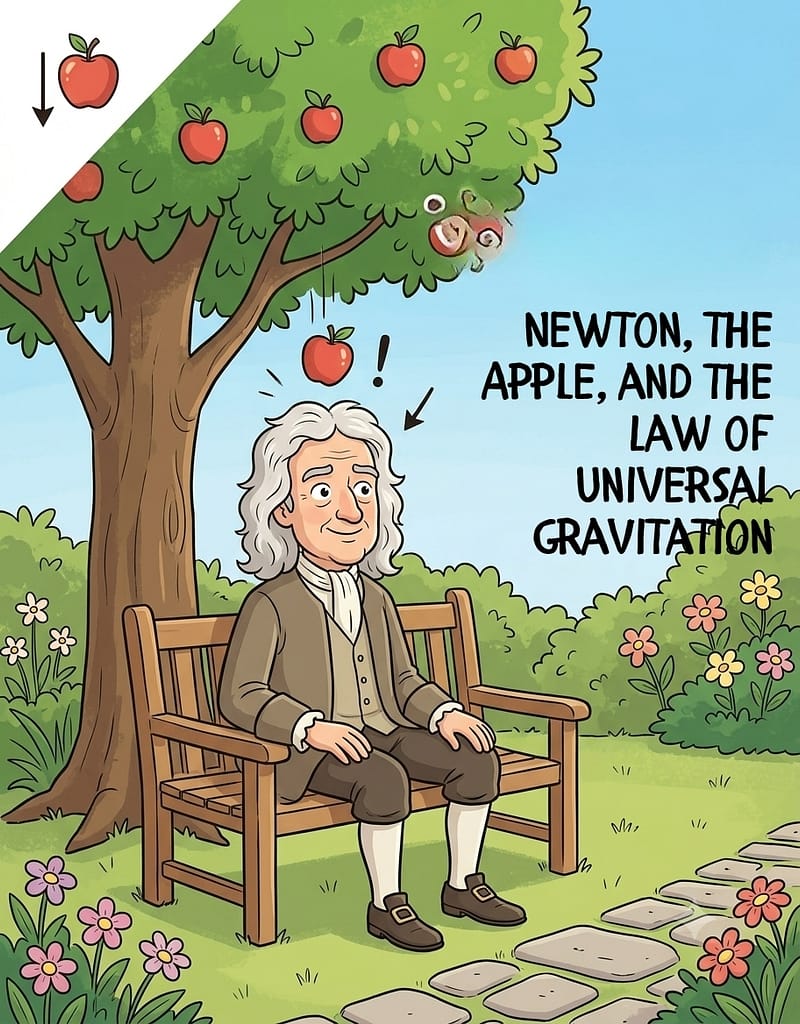
A friend who visited Newton after he grew old describes the conversation between them as follows: “After dinner on a warm day, we had gone out into the garden and were sitting under the apple trees. While talking about other topics, he said that the concept of gravity came to his mind in a similar situation. It had all started with the fall of an apple. He asked himself why the apple always descended straight to the ground, why it didn’t fall to the side or up in the air, but always toward the center of the earth. The reason for this was that the earth was pulling the apple. There was an attractive power in matter, and the earth’s gravitational power was at the center of the earth. Just as the earth pulled the apple, the apple pulled the earth. But when matter pulled matter, this attraction power had to be proportional to the quantity of matter, so the apple fell to the ground. Newton said that this power we call gravity existed in the entire Universe.” After finding the law of gravity, Newton was not satisfied with this alone and also set about calculating what law kept the Moon in its orbit…
A Battery from a Frog’s Leg… The Italian physiologist Luigi Galvani, who lived between 1737 and 1798, is known as the first scientist to find the electric current. During his investigations, Galvani noticed that a severed frog’s leg he left next to an electrostatic generator moved. Continuing his research in this field, which he called “animal electricity,” he hung a frog’s leg with a brass clip on the iron railing of the balcony and noticed that the leg contracted when it touched another part of the railing.
This experiment of Galvani attracted the attention of the Italian physicist Alessandro Volta, like many scientists. Volta argued that the frog’s leg twitched not because of animal electricity, but because of the potential difference between the brass of the clip and the iron of the railing. According to Volta, the frog’s muscles and nerves revealed a current too low to be measured with the devices of that time. Volta proved the theory of different electrical voltages in different metals by creating the first battery consisting of a series where cells made of two separate metals, such as copper and zinc, were separated by moistened cardboards.
The power (voltage) of the battery formed by these “galvanic” cells depended on how many cells the battery consisted of. Previously, high voltage was provided from electrostatic generators used to obtain electricity, but it was not possible to obtain a continuous current. Continuous current was obtained for the first time from these batteries, and even in its very primitive form, the Volta battery led to important electrochemical discoveries such as Sir Humphry Davy’s discovery of sodium and potassium elements.
Smallpox Vaccine… Smallpox, which was quite common until the 19th century, caused mass deaths just like plague and malaria. Edward Jenner, who found the smallpox vaccine by chance, saved millions of people from the horrific death caused by smallpox and opened an important path for the development of other vaccines. Jenner’s discovery of the smallpox vaccine did not happen as a result of long and feverish work at all. When he was nineteen years old, a woman milking cows told him she was sure she would not catch smallpox because she had previously caught cowpox seen in cows.
Remembering this interesting conversation after becoming a physician, Jenner made observations and found that women who had previously caught “cowpox seen in cows” did not catch smallpox. The idea of vaccinating people with cowpox to prevent them from catching deadly smallpox sprouted in Jenner this way. In 1781, Jenner injected cowpox microbes into an 8-year-old boy, and a year later, he injected smallpox microbes little by little into the same boy, proving with this risky experiment that the boy did not catch smallpox.
The vaccine was found by injecting the substance taken from the wounds of a person infected with cowpox into a person infected with smallpox. Thanks to this discovery, many vaccines began to be developed for different diseases using the same method. For example, Pasteur, inspired by Jenner’s method, developed vaccines for poultry cholera and rabies.
The Invention of Photography… Photography was invented in 1838 by the Frenchman Daguerre, who used a “camera obscura” (darkroom) as a result of an accident. The camera, consisting of a box, had a lens on one side and a glass plate on the other side where the image was reflected. The camera had already been designed by Leonardo da Vinci in 1519; in 1573, E. Danti corrected the inverted image with the help of a mirror placed behind the lens. Until the mid-1800s, “camera obscura” was used to copy images by placing a thin paper behind a glass plate.
Another Frenchman named J. N. Niepce used asphaltum, whose solubility decreased after being exposed to light and passed through certain solutions, to obtain a permanent image from the “camera obscura”. With this method, the world’s first photograph was obtained in 1822, even if the image was faint. Meanwhile, Daguerre was continuing his experiments with silver salts sensitive to the decomposition of light. Influenced by each other’s research, these two people started working together, but Niepce died shortly after. Continuing his work alone, Daguerre exposed polished silver-plated copper plates to iodide vapor and obtained a thin silver iodide coating. By exposing these plates, which he prepared using the “camera obscura”, he managed to obtain faint images.
Trying many ways to improve image quality, Daguerre wiped one of the plates he exposed and placed it in a cabinet containing various chemical solutions to use it again. When he looked at the plate a few days later, he noticed that the image had strengthened. To find out which solution did this, Daguerre started an experiment by removing the solutions from the cabinet one by one , and finally faced an empty cabinet. While examining the remaining empty cabinet, he discovered that mercury leaking from a thermometer previously broken inside the cabinet strengthened the image. The “Daguerreotype” photograph that emerged in this way became widespread as a result of washing an exposed plate with mercury heated up to 75°C. Research led to washing silver iodide, which does not interact with light, with known salt (sodium chloride), and later to the discovery of “hypo” (sodium hyposulfite). This last method is still used in black-and-white photography technique…
The Use of Nitrous Oxide in Anesthesia… One of the gases that Joseph Priestley discovered and experimented with before finding oxygen was nitrous oxide. Over time, it was seen that this gas was non-toxic, but when inhaled, it had some effects on people such as singing, laughing, and fighting. These laughing fits led to nitrous oxide gas being referred to as “laughing gas”. Humphry Davy, who was appointed head of an institute researching the medical uses of various gases in 1798 when he was only 20 years old, discovered while examining nitrous oxide that this gas caused temporary fainting if inhaled for a long time. The idea of Davy, who became quite famous by revealing various chemical elements and their structures, that nitrous oxide gas could be used in medical operations was, for some reason, not adopted by anyone. The use of nitrous oxide, which was used only for entertainment purposes until the beginning of the nineteenth century, for anesthesia purposes in medicine began as a result of an accident during a show held in 1844.
Samuel Cooley, a friend of a dentist named Horace Wells who was among the audience, volunteered to inhale the gas. Becoming aggressive after inhaling the gas and attacking other volunteers, Cooley calmed down after fighting for a while and took his place back among the audience. Noticing that his friend’s leg was bleeding as a result of a blow received in the fight, Wells witnessed that Cooley felt nothing even though his leg was cut deeply. Quite impressed by this event, Wells thought that he could use this gas to prevent the patient from feeling pain while extracting teeth.
The dentist called a friend, used the gas on himself for the first time, and saw that he really felt no pain while having his tooth extracted. This was how nitrous oxide began to be used for anesthesia. Diethyl ether, another substance used in anesthesia, was found through the work of another group of scientists who opposed this method. Nitrous oxide and diethyl ether are still used for anesthesia in medicine…
Molecular Architecture Coming with Kekulé’s Dream… In the early 18th century, gas obtained from whale oil was used to illuminate theaters and public buildings in London. Conducting research on this gas, the famous scientist Michael Faraday discovered in 1825 that the gas consisted of equal amounts of carbon and hydrogen. Until then, in compounds known to contain carbon and hydrogen, carbon atoms were always in a lower ratio compared to hydrogen atoms. But in this gas, named benzene ($C_6H_6$), the ratio was 1:1.
Before 1858, organic chemists were making extraordinary discoveries, but they could not bring any logical explanation to these discoveries. Therefore, the structural formula of benzene could not be established until 1865. In 1828, Friedrich Wöhler showed that urea carried the same ratio of carbon, hydrogen, oxygen, and nitrogen (ratio 1:4:1:2) as ammonium cyanate, yet these two substances were different from each other. They were said to be isomers, but no one knew how the atoms of these two substances carrying elements in the same ratio were bonded.
Perhaps, if Friedrich August Kekulé had not fallen asleep on the bus while returning home late at night from a friend with whom he discussed chemistry on a summer evening, all this would have remained a secret for a while longer. Kekulé, who said, “Atoms were spinning before my eyes; since I started interested in atoms, I always thought of them as in motion, but I could never solve the nature of their movements. Now, two small atoms were combining with each other to form a pair, and a larger atom was taking them in. Larger atoms were bonding to three or even four small atoms, then they all combined and danced, dragging the small atoms bound to them around. I was awakened by the driver. As soon as I came home, I drew this strange dream on paper,” explains how the “Structural Theory of Molecules” emerged.
Kekulé’s second dream helped explain the structural shape of benzene. “I fell asleep while trying to maintain an unproductive research. Atoms were spinning before my eyes again, dancing and forming chains. Small groups acting more humbly this time stayed in the background. I saw one of the chains twisting like a snake start spinning as if mocking me by biting its own tail, and I woke up immediately, formed a hypothesis, and continued my work.” Inspired by the bonds he saw in his first dream, Kekulé drew the molecular formula where carbon forms a quadruple valence bond, and by his second dream, the ring-shaped molecular formula of benzene where six carbon atoms combine with six hydrogens. Showing that the double valence bond between carbons changes constantly and that isomers would not form for benzene if other atoms replaced hydrogen, Kekulé also revealed how Wöhler’s substances containing atoms in the same ratio bonded with each other through a method he developed. The theory that atoms bonded to each other with their electrons was the same as the quantum mechanics view unknown at that time, and all this came to light thanks to two dreams…
Insulin… In 1889, two scientists named Joseph von Mering and Oscar Minkowski, who were investigating the function of the pancreas in digestion, removed a dog’s pancreas. The next day, when they saw flies swarming around the dog’s urine, they decided to analyze the urine. As a result of the analysis, they saw that the urine was loaded with sugar. Knowing that sugar in urine is an important symptom of diabetes, the scientists investigated the relationship between diabetes and the pancreas and discovered that the pancreas produced a secretion to control sugar use. In cases where this secretion was absent, sugar metabolism was disrupted and diabetes symptoms appeared.
John J.R. MacLeod and his student Frederick G. Banting, conducting their research within the framework of these results, took this secretion from a dog’s pancreas and injected it into another dog whose pancreas had been removed previously and showed diabetes. The two scientists saw that the dog recovered after a while. Naming this secretion insulin, the scientists continued their research on isolating the hormone from the pancreas and standardizing the dosage. Within a year, they found that insulin obtained from cattle pancreas had an alleviating effect on people’s diabetes symptoms.
Insulin, a protein, is a natural polymer consisting of two chains bound to each other with 51 amino acids in a special arrangement. Amino acid sequences, which vary from animal to animal, show very little difference between specific animal species, but these differences are not at a level to affect the regulation of human carbohydrate metabolism. Insulin obtained from some animals could cause allergies. But recently, researchers using the bacterium named Escherichia coli also succeeded in obtaining human insulin…
Safety Glass… French chemist Edouard Benedictus dropped a test tube from his hand while working in his laboratory in 1903. When he looked at the tube, he saw that the glass did not scatter around and that the tube maintained its original shape despite the cracks. Examining this glass, Benedictus saw that what held the glass together was a thin film, and discovered that this film was formed from the vapor of collodion (cellulose nitrate prepared from cotton and nitric acid) previously inside the tube. Leaving this discovery aside, Benedictus developed his invention further and put the first safety glass on the market some time later, when he heard that a young girl was severely injured by shattered glass in a traffic accident.
Penicillin… The most known of accidental discoveries is Sir Alexander Fleming’s penicillin. Fleming was sent to France during World War I. In those times, antiseptics were widely used to heal war wounds. Observing that phenol, one of these, had more harm than healing effect, Fleming discovered that this substance killed leukocytes (white blood cells) faster than bacteria, which was harmful. Because he knew that leukocytes played an important role in the body’s defense against bacteria.
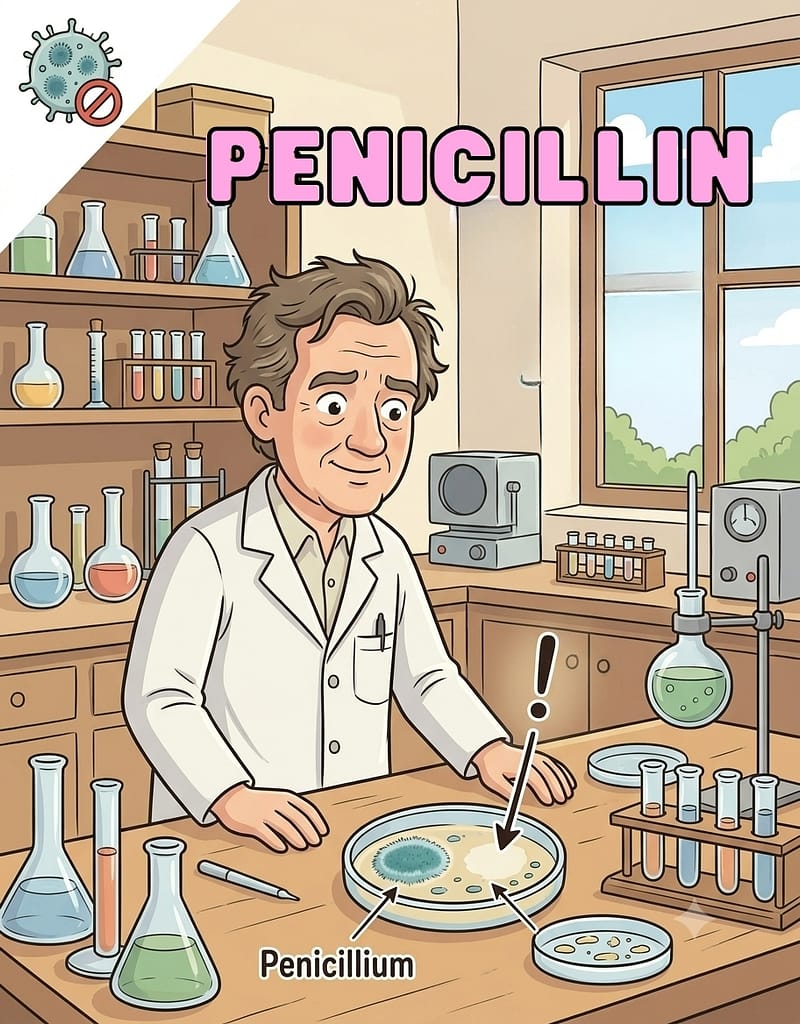
In 1922, as a result of an unexpected event, Fleming found an antibiotic that killed bacteria but did not kill leukocytes. Catching the flu, Fleming obtained a culture from his own nasal discharge. While examining this, a tear from his eye fell into the petri dish. When examining the culture the next day, he found a clear area where the tear had fallen. Concluding that the tear, which he named lysozyme, killed bacteria, Fleming left this discovery aside because he thought the dead microbes were not very harmful.
In 1928, while working on cold discharge cultures, Fleming remembered his previous experiment when he encountered a clear area in a petri dish; upon examining the clear area, he saw that a piece of mold had fallen into the dish while it was open. Examining the mold, Fleming determined that it belonged to the Penicillium genus and named this antibiotic he found penicillin. Fleming describes his discovery as follows: “If I hadn’t had my previous experience with lysozyme, I would have thought the culture in the petri dish was spoiled and thrown the dish away. But by chance, a mold that could be effective against this bacterium fell into the dish and helped me find penicillin.” Indeed, later on, it was seen that penicillin was effective against many bacteria and took its place in life as an important substance in the treatment of diseases…
Teflon! From the Atom Bomb to the Frying Pan… Teflon is the market name for polytetrafluoroethylene. Teflon was found in 1938 as a result of another interesting process. Dr. Roy J. Plunkett, who wanted to obtain a non-toxic refrigerant from tetrafluoroethylene gas, saw that no gas came out when he opened the valve of the gas-filled tank he was experimenting with. This was quite strange because indicators showed that the tank was full. Plunkett thought of reviewing this strange situation instead of continuing his refrigerant works on another tank. When he opened the inside of the tank, he found a slippery white powder at the bottom of the tank. Being a chemist, Plunkett immediately understood this new formation: the molecules of tetrafluoroethylene gas had bonded with each other to form a solid substance.
This white powder had interesting properties. The powder, which was heavier than sand, was much more slippery than sand. It was also understood that the powder, which could not be dissolved by any solvent, was not affected by strong acids, bases, and heat. Perhaps, when it was realized that this substance, which would be left aside for a long time, was the only substance that resisted the corrosive effect of uranium hexafluoride used in the production of U in the atom bomb during World War II, studies were developed and maintained. The presentation of teflon to the market as a non-stick frying pan, whose production was entirely used for war purposes, happened only after 1960. Teflon is still used in many places from electrical and telephone cables to space rockets and astronaut suits… Teflon, one of the rarest substances that the body does not reject, is also used as a prosthesis…
We have seen that many performed inventions emerged as a result of an accident or chance, but what is even more important than all these is that the person who makes the invention observes these accidents or chances with an investigative eye and turns them into inventions. Many scientists turning accidents and chances into inventions has been thanks to the “invention-ready mind” that allows them to examine many formations, investigate with curiosity, and establish a connection with the subject they are working on.