
In recent years, we’ve frequently heard reports in the news about the depletion of energy resources. Increasing energy needs also lead to increased energy consumption. We also encounter reports on television, in newspapers, and in magazines about the world warming. According to scientists, all of these are interconnected, and the global warming is caused by the excessive release of carbon dioxide gas into the air due to the energy sources we use. Today, all countries are trying to find solutions to these problems. Everyone agrees that it’s time to start using clean energy sources.
We need energy to do any work. Energy lights our cities, powers our cars, trains, and airplanes. We heat our homes, cook our meals, play our favorite songs on the radio, and watch movies on television.
Energy powers the machines in factories and the tractors on farms. The sun, our largest energy source, provides us with light throughout the day. We also need energy to live. Plants produce their own food using the energy they receive from the sun. Animals obtain energy by eating plants and some animals. The energy stored in food is converted into energy for work in our bodies. We expend this energy when we run, walk, think, read, or write.
Energy causes matter to move or change. There are two types of energy: kinetic energy and potential energy. The energy in moving matter is called “kinetic energy.” Matter, They may also possess energy due to their position in certain force fields, such as gravity or magnetic fields. This is called “potential energy.”
Energy can exist in various forms, such as heat, light, mechanical energy, electrical energy, chemical energy, and nuclear energy.
Electrical energy is created by the movement of electrons between atoms. A lightning flash is an example of electrical energy. Light energy is electromagnetic energy that travels in the form of transverse waves.
Thermal energy is generated by the movement and vibration of atoms and molecules within substances. Chemical energy is the energy stored in the bonds of atoms and molecules. This energy holds these particles together. It is the chemical energy in food. Nuclear energy is the stored energy that holds the nucleus of an atom together. This is released when nuclei combine or split. Energy can transform from one form to another. For example, when a battery is connected to a circuit, the chemical energy in the battery is converted into electrical energy. The chemical energy we obtain from food is stored in our bodies. When we move, this energy is converted into kinetic energy. The initial amount of energy is the same as after the transformation. In other words, energy cannot be created or destroyed; it can only be transformed from one form to another.
This is called the “law of conservation of energy.” In some cases, when one form of energy is transformed into another, some of it can also be transformed into another form. For example, when converting electrical energy into light energy, some of the electrical energy is transformed into thermal energy. Another energy transformation occurs due to friction. The resistance between two objects is called “friction.” During friction, some of the energy is also transformed into thermal and sound energy. Have you ever heard the sound of a moving car suddenly braking? Furthermore, the tires also get hot.
Energy is usually measured in a unit called a joule (J). A thousand joules is one kilojoule (kJ). A buttered toast you eat in the morning contains approximately 315 kilojoules of energy. Do you know what you can do with this energy? Here are a few options. With the energy your body stores when you eat this toast, you can run at a slow pace for 6 minutes, cycle for 10 minutes, walk briskly for 15 minutes, and sleep for 1 to 1.5 hours!
Our Energy Sources
Most of the energy needed for life on Earth comes from the Sun. This energy is, in fact, the primary source of all energy sources currently in existence. Solar energy triggers a series of events that lead to the formation of winds, the movement of water, and the growth of plants. Plants convert solar energy into chemical energy. They store this energy in their food. A large portion of this stored chemical energy is converted into thermal energy. The remaining portion is used for plant growth. Creatures that feed on plants store the energy they obtain from them in their bodies. This energy then travels to the highest levels of the food pyramid.
Our Earth is, in fact, a major source of thermal energy. The sun, wind, water, and plants constitute the primary energy sources on Earth. The energy we obtain from the sun is called solar energy, the energy we obtain from the wind is called wind energy, the energy we obtain from plants is called biomass, the energy we obtain from hot waters coming from deep within the earth is called geothermal energy, and the energy obtained from the movement of water is called hydroelectric energy. These are renewable energy sources.
Renewable energy sources are inexhaustible because they can be regenerated in a short time. The sun always shines, the wind always blows, and rivers always flow.
Some of these energy sources also consist of the remains of living things. These remains become usable as fuel after processes spanning hundreds of millions of years. During this process, these residues buried under rocks and mud undergo transformation under high pressure and temperature, transforming into coal, oil, or natural gas. These are called fossil fuels. Fossil fuels are mined from underground and used after undergoing the necessary processing.
Another energy source is uranium, also mined underground. This mineral can provide vast amounts of energy in nuclear power plants. Energy sources like uranium and fossil fuels are non-renewable because their natural abundance is limited. For example, petroleum was formed by the remains of ancient marine plants and animals remaining buried deep in the earth for millions of years.
Fossil Fuels
Fuels such as coal, oil, and natural gas are called fossil fuels because all three formed hundreds of millions of years ago. When trees and plants died, they sank to the ocean floor, forming spongy layers called bog coal. These layers were then covered with sand, clay, and other minerals.
These formed sedimentary rocks. Over time, more rock accumulated and began to compress the bog coal at the bottom. Over millions of years, these residues transformed into coal, oil, and natural gas.
Coal is extracted from the ground by various methods. These are then transported by train, boat, and pipeline. Special wells are drilled to bring the oil to the surface.
Natural gas is found near oil fields. During the oil extraction process, this natural gas and water must first be drained through pipes. Then, the oil is pumped directly to a treatment plant. After extraction, the natural gas is cleaned and liquefied for transportation. Natural gas, a gas lighter than air, contains mostly methane. Methane is a simple chemical compound composed of carbon and hydrogen atoms. Because it is an odorless gas, its presence is not easily detected. For this reason, after being extracted from underground, it is mixed with a chemical that produces a strong odor before being sent to storage facilities through pipelines. This is to ensure that the odor can be detected in the event of a gas leak.
Nuclear Energy
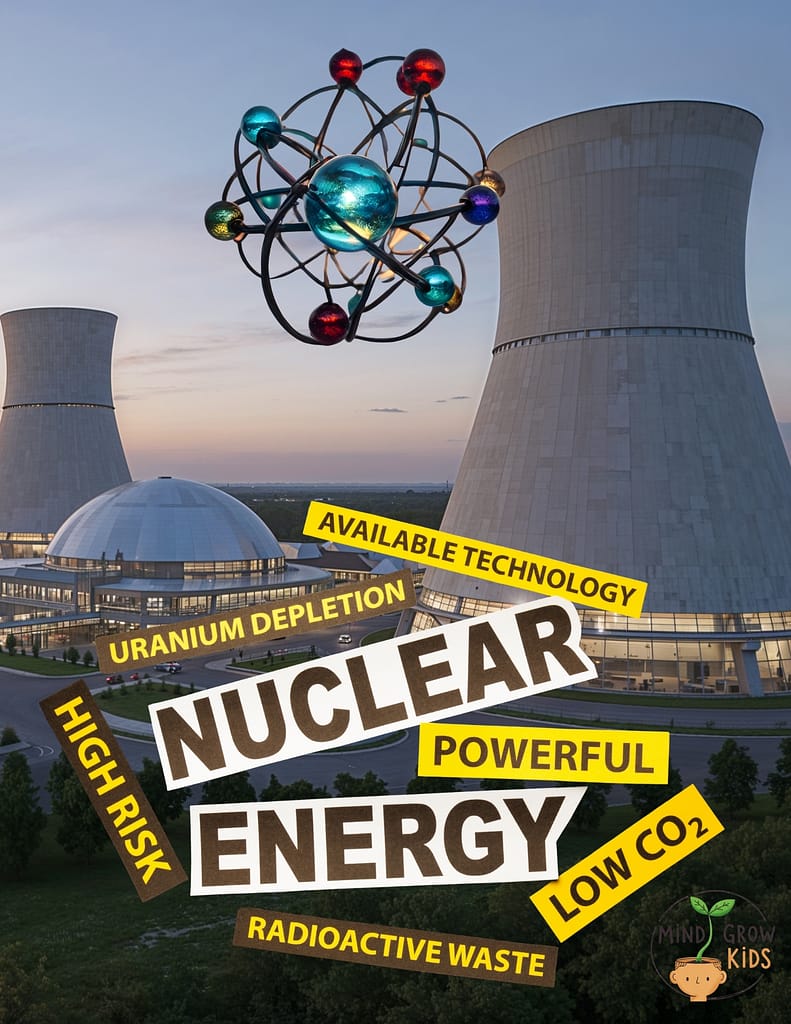
Nuclear energy is a very powerful energy source. It helps hold the nucleus of an atom together. When an atom’s nucleus splits, vast amounts of energy are released. If released slowly and in a controlled manner, this energy can be used to generate electricity. If released quickly, it can cause a massive explosion.
Uranium is used as fuel in a nuclear power plant. Uranium is an element found in many places underground. The extracted uranium is processed into small pellets and packed into long rods. It is then placed in the power plant’s reactor. There, the uranium atom is split through controlled chain reactions. In chain reactions, particles released from the splitting of an atom cause other uranium atoms to split. The particles released from the newly split atoms, in turn, split other atoms. This splitting is controlled by control rods. The heat energy released creates steam, which, in turn, turns a turbine to generate electricity. As a result of these reactions, radioactive waste, in addition to energy, is also created. This waste can cause great harm to humans and all living things. For this reason, radioactive waste is placed in solid form in special vaults and buried deep underground.
What is Electricity?
Electricity is a secondary energy source because it is obtained by converting fossil fuels or other natural energy sources. The story of electricity, which we use in every moment of our daily lives, first began with Benjamin Franklin. Benjamin Franklin demonstrated that lightning was a form of electricity. He flew a kite attached to a metal key and launched it into storm clouds.
When lightning struck the key, sparks flew from it. However, this was a very dangerous experiment because electric current is harmful to humans.
Michael Faraday’s research on electricity and magnetism led to the invention of the electric motor and the development of large-scale electricity-generating systems. Thomas Edison’s invention of the light bulb changed our lives. Nikola Tesla’s work led to many new inventions that enabled the production, transmission, and delivery of electricity to our homes.
Biomass Energy

The total weight of living organisms in a given area is called biomass. Biomass can be used directly as an energy source, or its waste can be used for this purpose. Biomass energy can be obtained from livestock droppings, food waste, dead trees, tree branches, crops, wood chips, bark, and sawdust. Using biomass as fuel also reduces landfill use. Waste and residues used for biomass energy are collected by large trucks and transported to the power plant. There, they are dumped into a waste pit and incinerated. During combustion, hot gases are produced. The heat released from these processes boils the water in the boilers, and the steam generated during this boiling process is used to turn the turbines. Another method of generating energy from biomass is to allow waste and residues to decompose in holding tanks. The decomposing waste in these tanks produces methane gas. This gas is then burned for heating. The same method can also be applied to animal feces. New ways to generate energy from biomass are still being researched. One of these is ethanol production. It is thought that ethanol could be used as a fuel in some vehicles instead of gasoline.
Solar Energy
Solar energy, a renewable energy source, is widely used, especially in countries with abundant sunlight. This energy can be used to generate energy through various methods. One of these is solar power plants.
Here, curved reflectors, called “parabolic,” are used.
The curved reflectors focus sunlight onto a pipe at the center of the reflector. When the sun’s rays hit the pipe, the pipe heats up.
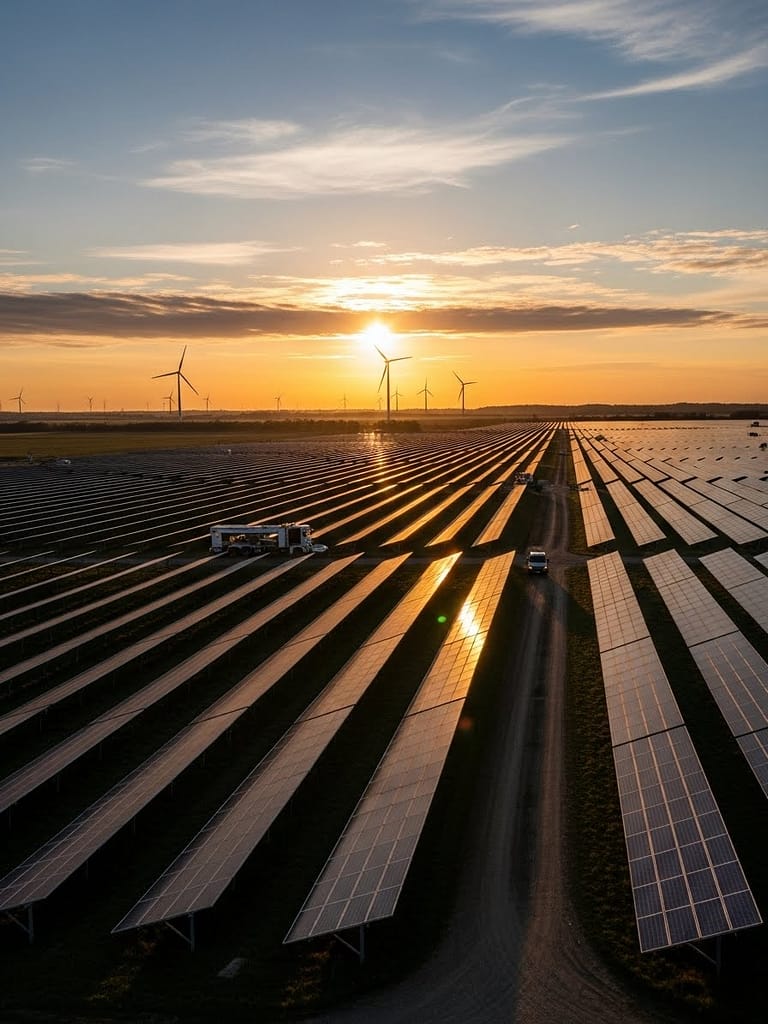
Once sufficiently heated, the pipe boils the water inside, vaporizing it. The resulting steam spins a turbine, generating electricity, just like other generators. Another way to harness solar energy is with solar cells. These cells convert solar energy directly into electricity. The most commonly used ones are made of silicon, the main ingredient in sand.
We can see these in small devices like calculators.
The Smallest Building Block of Matter
To better understand electricity, let’s recall the properties of atoms. Atoms are composed of tiny particles called protons, neutrons, and electrons.
Protons and neutrons form the nucleus of an atom. Electrons are negatively charged, protons are positively charged, and neutrons are uncharged. Electrons orbit the nuclei of atoms, much like the Moon orbits the Earth.
Each element is composed of different atoms. Atoms tend to have equal numbers of electrons and protons. This is what keeps atoms in balance.
In some atoms, electrons are held together by strong bonds, while in others, these bonds are weaker. Electrons can move from one atom to another. One electron bonds and the other separates. When two objects with different bonding strengths rub together, electrons are transferred to the one forming the stronger bond. The atom that loses an electron becomes positively charged, while the atom that gains an electron becomes negatively charged. Atoms with such unbalanced charges are called “ions.” Because all atoms tend to replace their missing electrons, atoms that are not balanced search for a free electron to replace the missing one. When electrons move between atoms, an electric current is created. This is precisely what happens in electrical wires. Electrons move from atom to atom, creating an electric current from one end of the wire to the other. Substances composed of atoms that hold their electrons with weaker bonds conduct electricity better. These substances are called “conductors.” Many metals (such as copper, aluminum, or iron) are good conductors. Substances that do not conduct electricity well are called “insulators.” Rubber, plastic, fabric, glass, and dry air are insulators.
How Does a Battery Generate Electricity?
Electricity flows in a closed electrical circuit. For electrons to move, a bridge must be established between them. A negatively charged electron cannot capture a positively charged atom spontaneously. To do this, a bridge must be established between the negative and positive regions. This bridge is called an electric circuit. If the circuit is open, electrons cannot move. A battery contains a solution and two different metals. This is how the battery produces electricity.
The reaction between the metals and the solution causes more electrons to be released from one of the metals.
One end of the battery is connected to one of the metals, and the other end to the other metal. The end that releases more electrons becomes positively charged, and the other end becomes negatively charged. If the two ends of the wire are connected to the terminals of the battery, electrons move along the wire to balance the electrical charge. If you connect a light bulb to this circuit, you can see electricity being conducted. The electrons leave the negative terminal of the battery, pass through the wire, and reach the bulb. They then pass through the wire inside the bulb and return to the battery.
Wind Energy
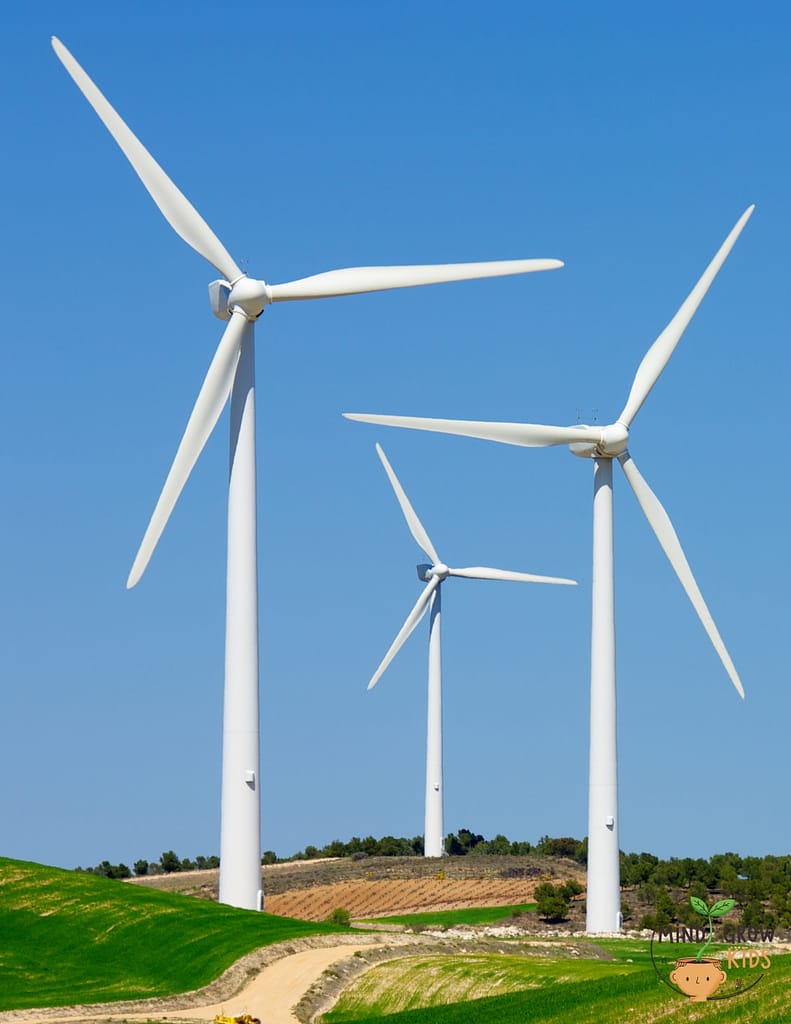
The kinetic energy of the wind can be converted into other forms of energy. One of these is electrical energy. The blowing wind turns the blades of a wind turbine.
The turbine’s blades are connected to a gear wheel, which in turn is connected to the turbine shaft. The rotation of the shaft generates electricity from the generator. A single wind turbine can meet the energy needs of a home or a school. The electricity generated from all the turbines in a wind farm is collected and sent to a transformer. There, the voltage is increased and the electricity is sent over long distances.
For wind turbines to operate efficiently, wind speeds generally need to exceed 19–23 km/h (12–18 mph). This allows the turbines to rotate at the speed required to generate electricity. Each wind turbine typically produces between 50 and 300 kilowatts of electricity. One kilowatt equals 1,000 watts. With 1,000 watts, you can light ten 100-watt light bulbs. A 300-kilowatt wind turbine can light 3,000 100-watt light bulbs.
Hydroelectric Power
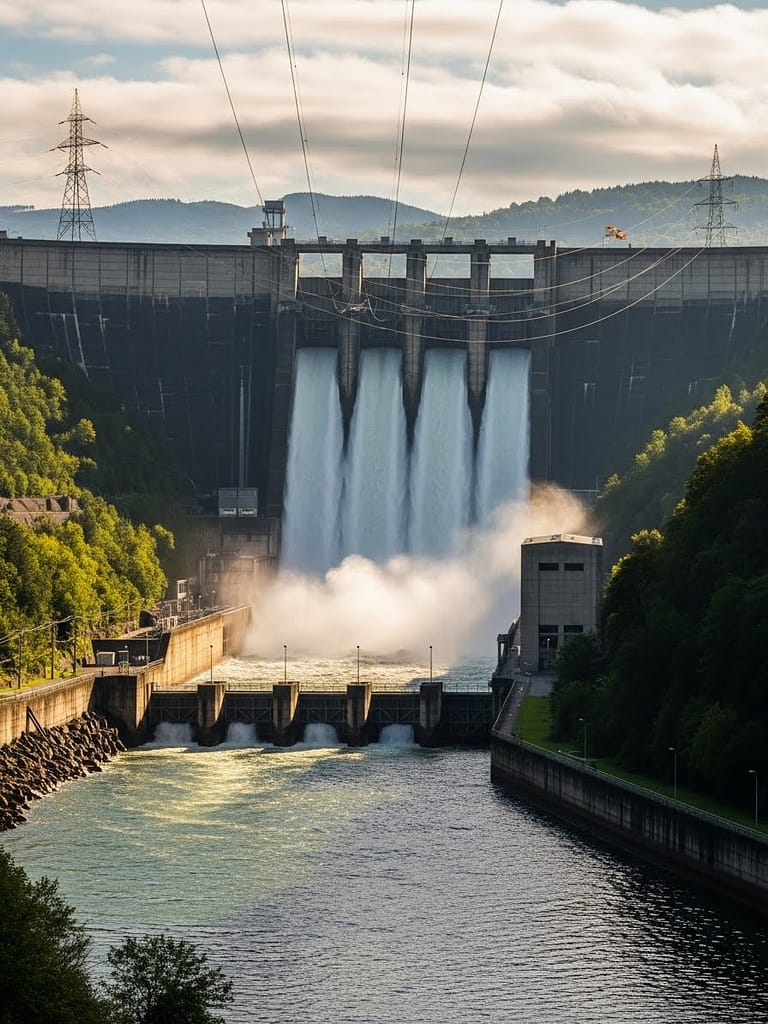
Another way to generate electricity is to harness the energy of moving water, or hydroelectric power. “Hydro” means water. Hydroelectricity is the process of generating electricity from the movement of water. To achieve this, dams are constructed across rivers to block the flowing water, creating a reservoir. This increases the water level and directs the stream directly to a hydroelectric power plant. The flowing water drives the turbines in the dam. The turbine’s rotation generates electricity, which is then transmitted to homes via dedicated power lines.
Hydrogen Energy
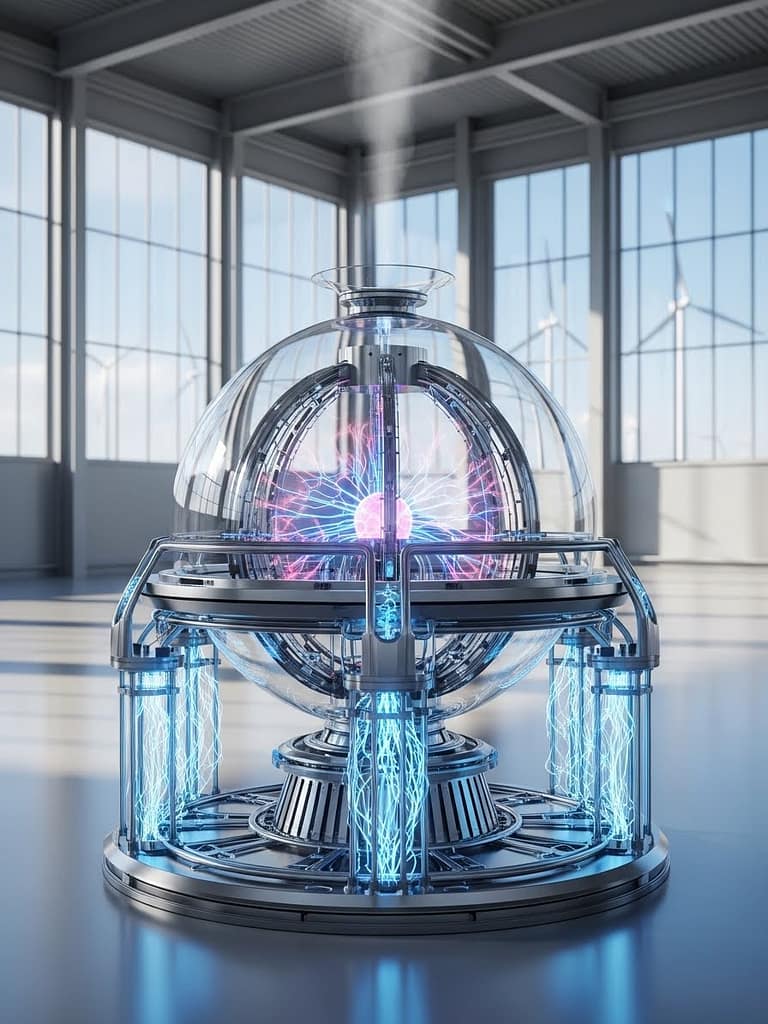
Hydrogen is a colorless, odorless gas that comprises 75% of the universe. On Earth, it is found combined with other elements such as oxygen, carbon, and nitrogen. To be used, hydrogen must be separated from these elements. Hydrogen is produced by applying heat to hydrocarbons. It is also possible to split water into oxygen and hydrogen using electricity. Some algae and bacteria can also release hydrogen using solar energy in some cases.
Today, hydrogen is used in the production of ammonia, petroleum refining, and methanol production. It is also used as a fuel, heat, electricity, and drinking water source for NASA’s space shuttles. Fuel cells are devices that convert hydrogen directly into electricity. It is envisioned that in the future, they could be used as fuel for all vehicles. There are even plans to use them as a source of electricity in homes, schools, and workplaces.
Hydrogen provides a very high level of energy as a fuel. Furthermore, it creates virtually no pollution. Hydrogen fuel cells even produce clean, drinkable water as a byproduct.
Fuel cells are a promising technology as a source of heat, electricity, and power. Some car companies have already begun working on vehicles powered by fuel cells. In these vehicles, an electrochemical device converts hydrogen from the air into electricity to power the electric motor and the vehicle. These vehicles, planned to run entirely on pure hydrogen in the future, will initially run on natural gas, methanol, or gasoline as fuel.
Hydrogen could also be used as a significant energy carrier in the future. In this case, the energy produced could be stored and transported to any desired location for use at any time. Thus, it could be used whenever needed.
Geothermal Energy
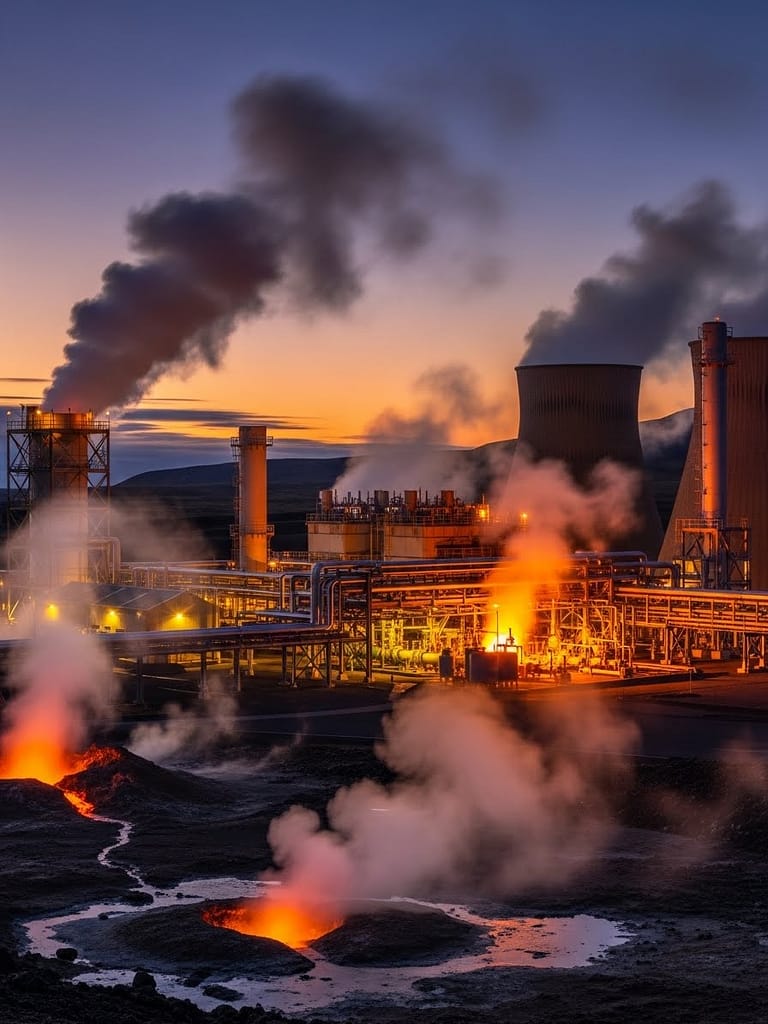
The word “geo” means Earth, and “thermal” means heat; geothermal means “Earth heat.” Beneath the Earth’s crust lies hot liquid rock called magma. The temperature of these rocks increases by 3ºC for every 100 meters underground. By the time you descend approximately 3,000 meters, the rocks are hot enough to boil water. If the water reaches this depth, it does not evaporate unless it meets the air, and it reaches temperatures above boiling point. This water can be used to generate electricity in geothermal power plants. In geothermal regions, two wells are drilled into the rocks several kilometers below ground. High-pressure water is pumped through one of these wells, fracturing the rocks. Cold water is pumped into the resulting cracks. The water, heated by the rocks, rises through the other well. In another application, hot water from underground is pumped directly to the surface.