What Would It Be Like If We Lived In Space?
Being in the weightless environment of space is very appealing to all of us. We envy the astronauts in documentaries who jump from wall to wall and perform various acrobatic moves effortlessly. It all seems fun to us. In fact, it’s not quite what we think. Since the beginning of manned space flights in the 1960s, scientists have discovered the challenges of being in the weightless environment of space. It’s not like flying around like Superman. In fact, gravity-free environments aren’t really for us. Our bodies have adapted to gravity. Our muscles and bones are strong enough to resist gravity when we stand, walk, or perform other physical movements. The center of balance in our inner ear uses gravity to keep us upright relative to the center of gravity. Because gravity also strongly pulls downward on the blood in our veins, our heart has the power to pump blood to our brain.
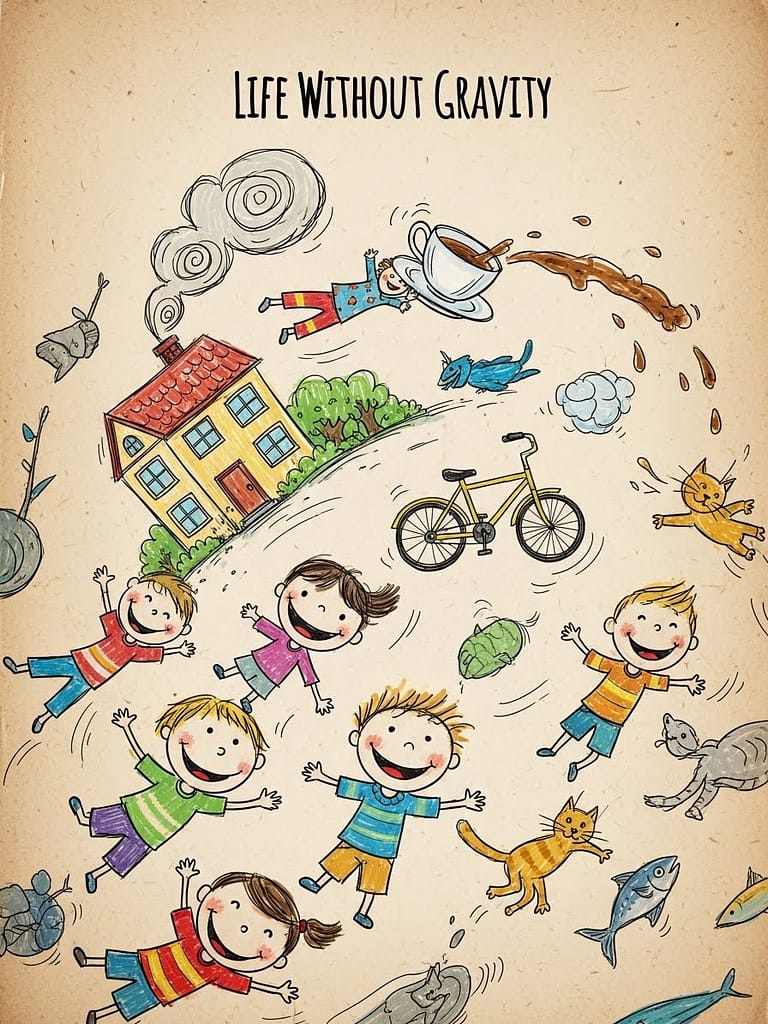
Because our bodies didn’t evolve to function in space, we experience some problems there. There are changes, particularly in blood circulation. In space, blood is drawn from the legs and concentrated in the head. This is a precaution the body takes against gravity. However, it doesn’t work for us in space and even creates some problems.
Due to the increased blood pressure in the head, astronauts feel as if they’re hanging upside down.
Astronauts grow a few centimeters taller in space because the discs between the vertebrae in the spine, which bear no weight, expand. This allows the spine to lengthen somewhat. At the same time, the bones soften. Because the muscles don’t have a large load to bear, they don’t exert much pressure on the bones. Therefore, bones weaken as they are not used. The situation is similar for muscles. They weaken because the load they can lift is greatly reduced. So much so that astronauts who spend long periods in space may be unable to stand up for a while upon returning to Earth.
The worst of these is nausea. Unable to sense gravity, the balance center in the inner ear becomes disoriented. This causes severe nausea and dizziness, especially in the first few days in space. Even the slightest shaking in a car or boat can make us dizzy. In space, this phenomenon is much more intense.
However, our bodies adapt to these major changes within a few days. The nausea passes, and appetite returns. The heart and spine adapt, and the discomfort subsides. That’s when the fun begins. Even though the spacecraft isn’t very large, it’s still like a bird.

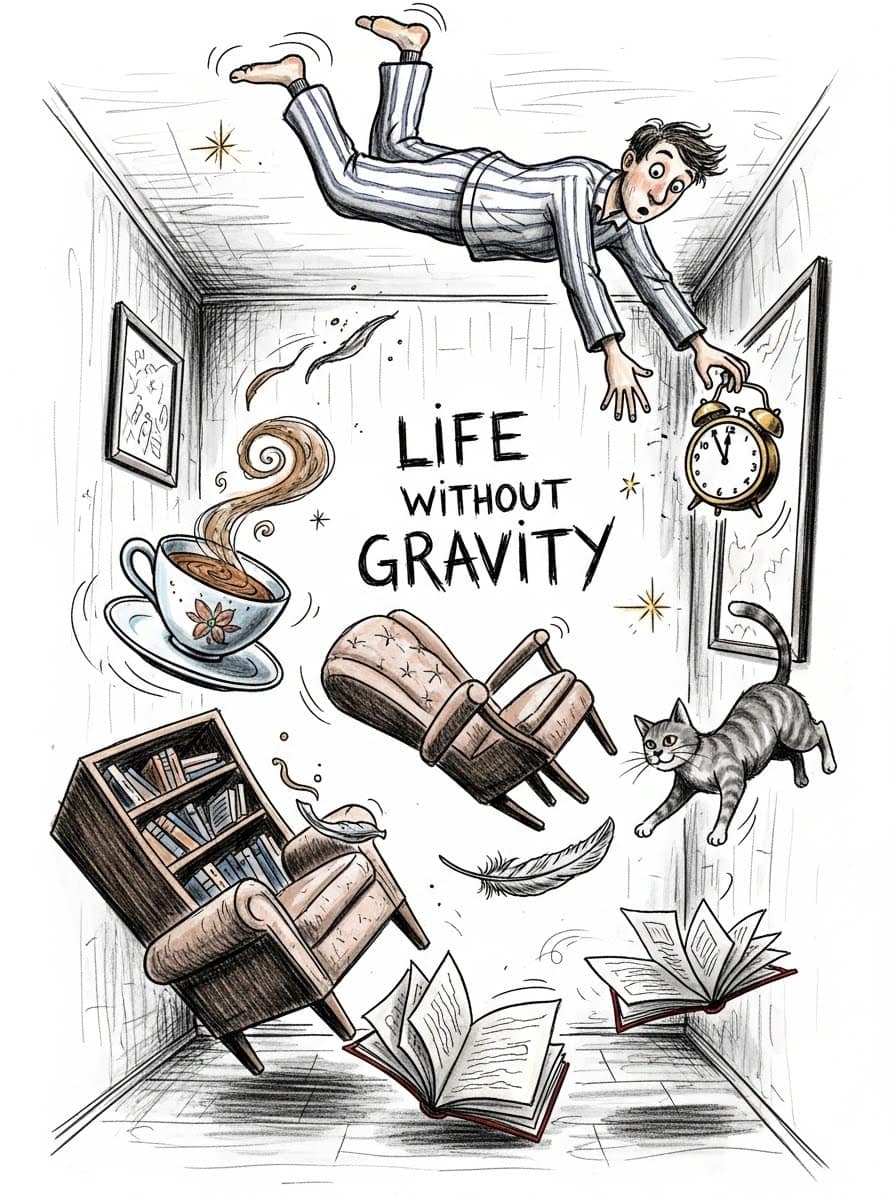
You can enjoy flying and jumping from floor to ceiling. However, it’s important to be careful. Hitting your head on something is a real possibility.
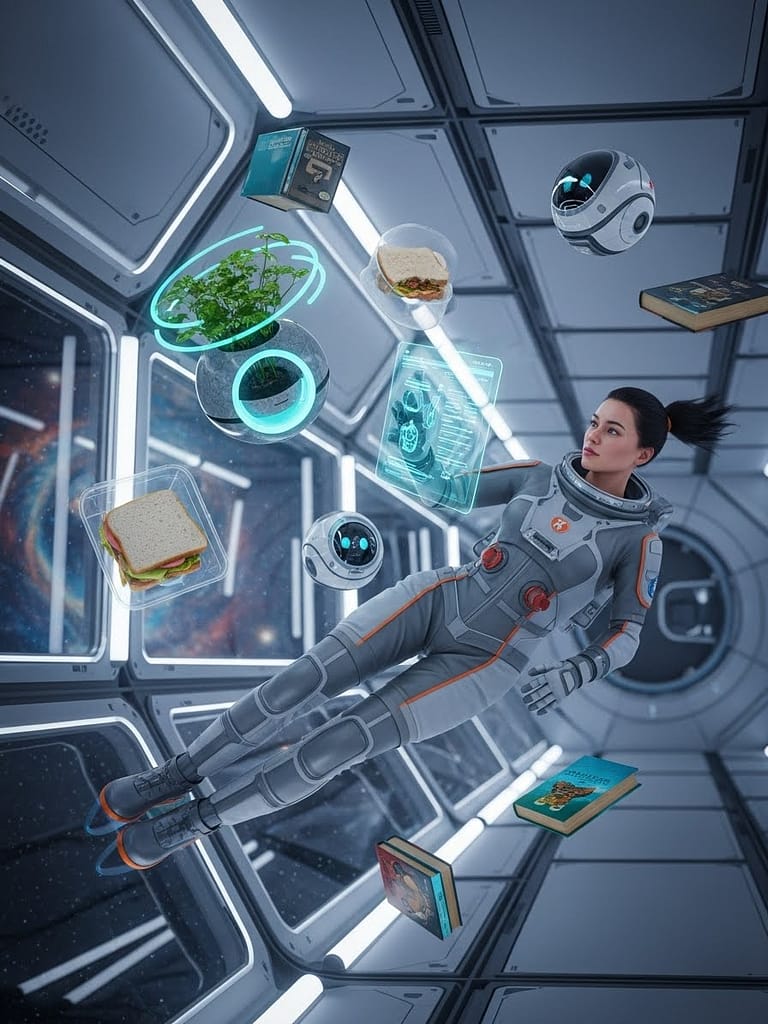
If you don’t properly secure the tools you use, you might not be able to find them where you left them. No matter how massive they are, they can fly away with even a small air current. You also need to completely change your eating habits. Food doesn’t have to stay on a plate, nor do drinks have to stay in a glass. For example, instead of staying in a bowl, popcorn is dispersed throughout the room by the air current. Milk behaves differently than popcorn. It can float in the air like a sphere without breaking apart. This is due to the surface tension in liquids. You can dip a straw into a floating milk ball and drink it.
However, it’s still undesirable for food and drinks to circulate freely inside, as uncontrolled flow can damage the devices. Astronauts generally drink liquids from closed containers with straws. They only use a fork and knife when eating solid foods. Since liquids don’t stay on a spoon, a spoon is of no use.
Astronauts exercise regularly every day to prevent excessive muscle and bone weakness. To stay healthy, they need approximately two hours of exercise a day. However, astronauts who spend more than two months in space experience various difficulties upon returning to Earth. These are primarily related to loss of strength due to muscle and osteoporosis. However, the human body can quickly recover and re-adapt to life on Earth.
Long-duration space flights are inevitable in the future. Currently, no manned missions beyond the Moon have been made. However, a trip to Mars is being considered in the near future. This alone would require a journey of at least six months. Whether the human body can withstand such a journey remains to be seen. For this reason, astronauts spend long periods of time in space stations orbiting Earth. The record for most time in space currently belongs to Russian cosmonaut Valeri Polyakov, who spent 428 days aboard the Mir Space Station in 1995. In light of these experiences, a future journey to Mars seems feasible, albeit somewhat challenging.