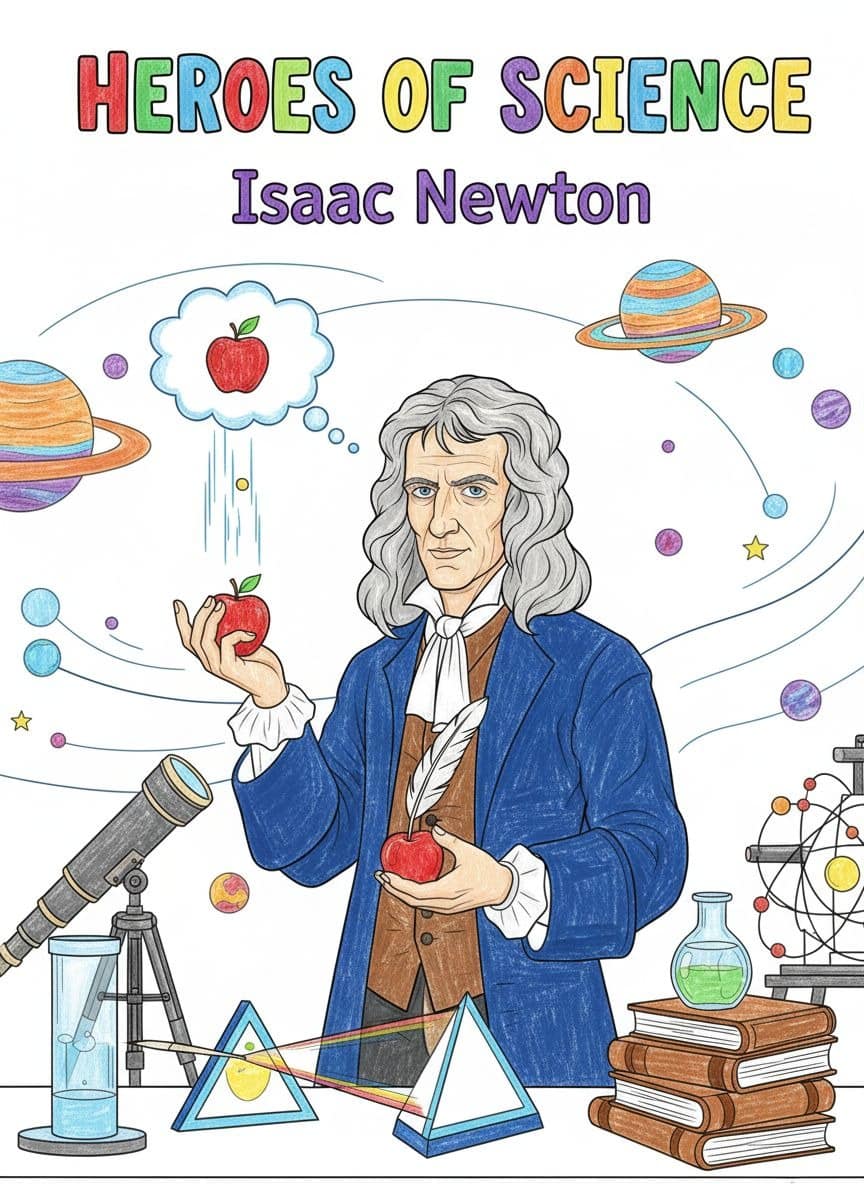
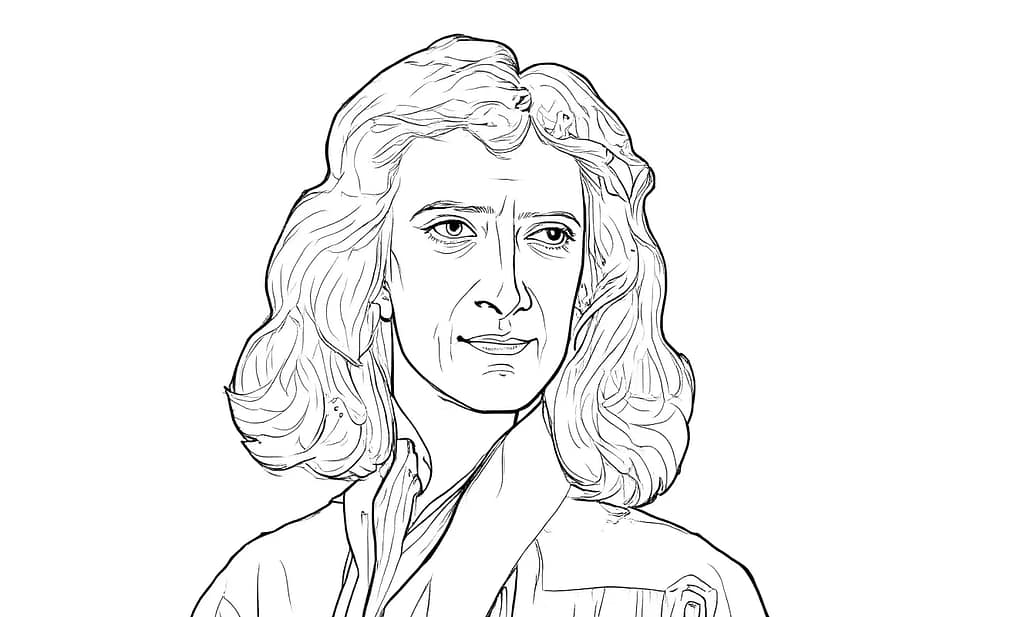

Hello, everyone. In this episode of the “Heroes of Science” series, we will tell the life story of Sir Isaac Newton, who made great contributions to the world of science and is considered the father of modern physics.
Newton was born on January 4, 1643, in England. His education began at The King’s School in Grantham. Newton attended The King’s School from the age of 12 to 17. In 1661, he entered Cambridge University, where he both studied and worked. Four years later, in 1665, he graduated from Cambridge with a degree in mathematics. After graduating, he spent the next two years formulating theories in the fields of mathematics, optics, and gravitation.
After these studies were completed, he became largely interested in the subject of optics. He began lecturing at the university on the two subjects he focused on: optics and astronomy. During this period, he invented the Newtonian telescope, the world’s first reflecting telescope. He later presented this invention to the Royal Society, along with a study on the refraction of light.
For the next 30 years, Newton continued his work on the laws of nature and the properties of light. In 1704, he wrote a book titled Opticks. This book showed how a prism could be used as a beam expander. The work he published before Opticks, titled Mathematical Principles of Natural Philosophy (often called the Principia), virtually transformed the scientific world. It contained the laws of motion, the universal laws of gravitation, and a collective application of Johannes Kepler’s laws of planetary motion.
With his works, Newton rose to a very important position in the scientific world. Not only was he admitted to the Royal Society, but he was also knighted by Queen Anne of England and received the title “Sir.” In the following years, this work was developed and reprinted, and Newton gained a wide fan base.
Newton spent the rest of his life continuing to work on mathematics, astronomy, and optics. In addition, he was appointed as the director of the Royal Mint and oversaw the process of minting new English coins. In 1703, he was appointed President of the Royal Society. In 1724, the aging Newton, whose health was deteriorating, moved with his niece and her husband to the Kensington area nearby. He passed away on March 31, 1727, at the age of 84.
Isaac Newton is regarded as one of the most influential scientists of all time due to his work. The English physicist Sir Isaac Newton is the architect of the classical mechanics laws used in the modern world. At the foundation of these laws are the theory of universal gravitation and the three laws of motion. Newton succeeded in unifying all these within a single system. Thanks to this work, he demonstrated that the motion of celestial bodies in space occurs according to a single law. At that time, the scientific world assumed the Sun was at the center of the universe, and thanks to Newton, the scientific world underwent a great change. It paved the way for Einstein’s theories of General and Special Relativity, which would emerge 200 years later.
Now, let’s take a look together at some striking facts about Isaac Newton’s life. Newton is the second scientist in history to receive a knighthood. His coat of arms features two shin bones crossed on a shield. In 1696, when new English coins were being minted, he was the director of the Royal Mint. During his tenure, he prosecuted 28 counterfeiters and had them convicted. His published work, Mathematical Principles of Natural Philosophy, contains almost all of today’s classical mechanics laws. However, the most important subject in the work was the controversial Universal Law of Gravitation. This law states that every mass in the universe attracts every other mass with a force proportional to the product of their masses and inversely proportional to the square of the distance between them. This theory unified the laws of motion that had been independently proposed years earlier by Johannes Kepler. Although Kepler did not receive much recognition during his lifetime, with these laws he was able to explain with astonishing accuracy how planets, satellites, and comets move in space.
Today, Albert Einstein’s General Theory of Relativity is used instead of Newton’s laws. With this theory, it is possible to define systems, especially very large-scale ones, much more precisely.
Now, let’s turn to the scientists inspired by this important physicist. One of these names is his student, William Whiston. After Newton left, Whiston became a professor and took over as the head of the mathematics department at Cambridge University. Today, his most well-known work is his studies on comets. Another scientist inspired by Newton is Albert Einstein. Newton’s laws of universal gravitation and classical mechanics formulas formed the basis of Einstein’s thoughts on astrophysics. Einstein later proposed the General and Special Theories of Relativity.
Considered by scientists to be one of the most influential people in history, Sir Isaac Newton ranks among the greatest physicists of all time, along with Einstein.