
Article: Speech and Language Therapist: Buket Öztekin
What are five well-intentioned mistakes that could slow down your child’s speech? Let’s take a look together.
In my years as a speech and language therapist, if I had a dollar for every time a loving parent asked me, “Why isn’t my child talking yet? What am I doing wrong?”… well, let’s just say I’d be writing this from a tropical beach. That question comes from a place of deep love and concern. But here’s the ironic truth I see every day: in your eagerness to hear their little voice, you might be using some common tactics that can accidentally put the brakes on their natural language development.
Let’s flip the script. Instead of focusing on what you should do, let’s talk about five well-intentioned habits you might want to gently let go of.

1. The “Say It!” Pressure Cooker
The Good Intention: You’re bursting with excitement! Every new word is a milestone, and you can’t wait to capture it. You want to encourage them, so you prompt, “Say ‘ball’! Can you say it?”
The Unintended Effect: This turns talking into a performance. For a hesitant child, that direct command can feel like a high-stakes test. The fear of getting it wrong can make them clam up entirely. We don’t just want parrots; we want communicators.
Try This Instead: Be a Narrator, Not a Drill Sergeant.
Forget the commands. Just immerse them in the word. If they’re looking at a ball, you become the friendly sports commentator of their life: “Wow, that’s a big ball!” “You found the ball!” “Let’s roll the ball.” You’re not asking for anything back; you’re simply giving them the gift of the word, wrapped in a real-life context.
2. The Endless Quiz Show
The Good Intention: You’re trying to engage them and check their understanding. It feels like active teaching, so you point at everything, asking, “What’s that? What color is this? How many are there?”
The Unintended Effect: This turns you from a playmate into a pop-quiz host. Conversation starts to feel like a constant examination, which is stressful and, frankly, not much fun for anyone.
Try This Instead: Be a Commentator, Not an Interrogator.
Put the questions on pause. Just describe the world together. If you’re watching a bird, try: “Look at that bird! It’s so high up. The bird has tiny feathers.” Then… stop. Get comfortable with the silence and count to ten in your head. This gives their brain the crucial time it needs to process what you’ve said and maybe, just maybe, form a response. If they don’t, no problem—you’ve already modeled great language.
3. The Mind-Reader Trap
The Good Intention: You know your child better than anyone. The moment their eyes flicker towards the juice cup, you’re already handing it to them. You’re being an attentive, responsive parent!
The Unintended Effect: You’ve just removed their reason to communicate. Why would they bother trying to say “juice” or even point to it, if the juice fairy (a.k.a. you) grants wishes before they’re even made?
Try This Instead: Play a Little “Hard to Get.”
Create gentle, low-pressure moments where they have to communicate. Put their favorite crackers in a clear jar they can’t open. Hold up two shirts and ask, “The blue one or the green one?” Then, wait. Watch their face. A point, a grunt, a gaze—that’s them talking! Acknowledge it (“Oh, you want the cracker!”) and respond. You’re teaching them that their voice (in all its forms) has power.
4. The Impatience for Progress
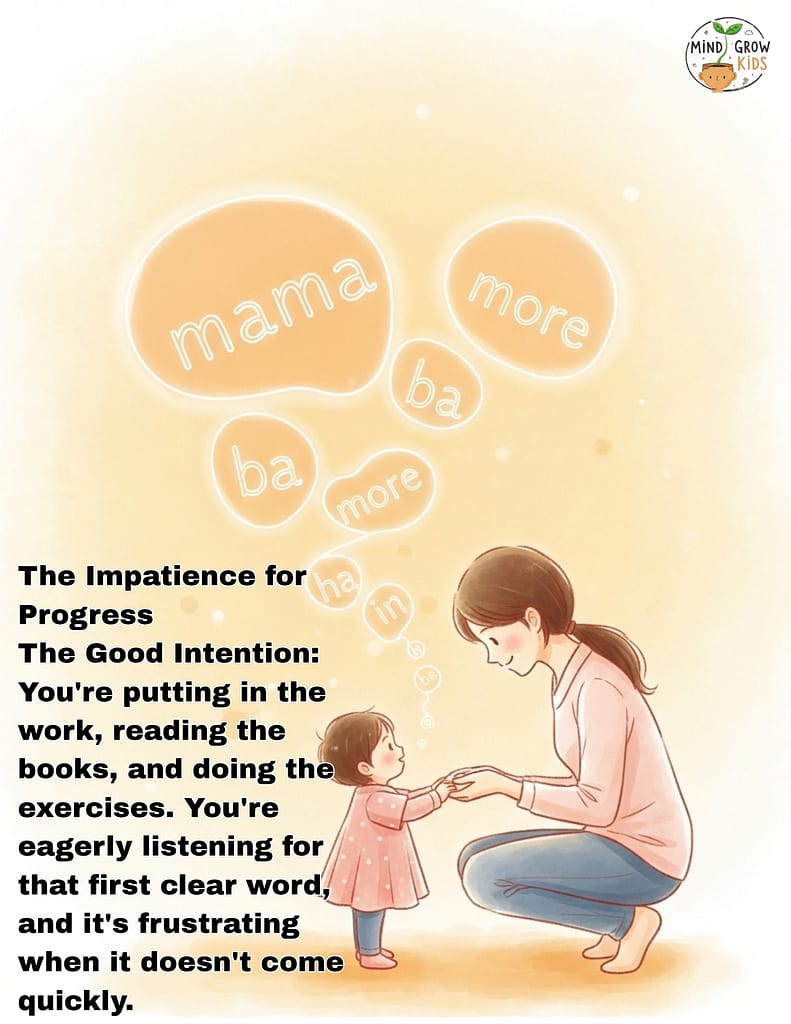
The Good Intention: You’re putting in the work, reading the books, and doing the exercises. You’re eagerly listening for that first clear word, and it’s frustrating when it doesn’t come quickly.
The Unintended Effect: Language isn’t a light switch; it’s a slow, beautiful sunrise. Focusing only on the final goal (a perfect word) makes you miss all the tiny, incredible steps along the way.
Try This Instead: Celebrate the “Almosts” and the “Not-Quites.”
Threw you a glance when you sang their song? That’s connection! Pointed at the dog? That’s joint attention! Made a “ba” sound when looking at a ball? That’s a phonological miracle! Cheer for these moments. This shift in focus reduces your frustration and builds their confidence, which is the true engine of language growth.

5. The Flashcard Fallacy
The Good Intention: You want your child to be smart and prepared. It feels productive to sit down and drill colors, numbers, and letters. You beam with pride when they can point to “red” on a card.
The Unintended Effect: For young children, especially under three, this is often “empty” knowledge. It’s not connected to their needs or desires. Knowing all the colors is far less useful than knowing how to ask for “more” or say “no.”
Try This Instead: Weave Learning into Life.
Ditch the flashcards for fun. You can teach “red” just as easily by saying, “Do you want to wear your red shoes or your blue ones?” while holding them up. This way, language is live, relevant, and tied to a real outcome. It has a job to do.
The Golden Thread: At the heart of it all, your role isn’t to be a teacher, but a connected, patient partner. The most powerful language lessons happen on the floor during play, in the high chair during meals, and in the cozy quiet of cuddle time. Follow their curiosity, talk about what they’re focused on, and keep the pressure off. You’ve got this.