Features of Games and Points to Consider During the Game-Playing Process
The games shared here are written for preschool teachers, all professionals who want to support children’s personal, social, and emotional skills, and adults who care for young children. Care has been taken to ensure that the compiled games are enjoyable for children and that they will want to repeat them, and that they are as simple as possible, easy to implement, and require minimal preparation and materials.
The games, compiled with consideration for the developmental characteristics of children in early childhood, are relatively structured to facilitate teachers’ implementation and focus on critical skills to most effectively support children’s social-emotional skills.
Teachers and parents can adapt this game to suit the interests, needs, developmental levels, region, environmental conditions, and opportunities of the children who will participate in the game. Children enjoy playing games they love and feel competent at over and over again. Therefore, the teacher should observe the children during play and give them the opportunity to play the games they are interested in and enjoy more often.
However, the teacher should introduce games that support different social-emotional skills to the children at regular intervals, making any necessary adjustments to the game if needed, and allow children to play different games.
In addition, it is important for the teacher to introduce games that support different social-emotional skills to children at regular intervals, making necessary adaptations to the games if needed, and to provide opportunities for children to play different games.
For the effective implementation of sensory games and the support of children’s social-emotional skills, it is important for the teacher to develop close cooperation with the child’s family and to involve the family in the educational process.
The teacher, in addition to their own observations, should gather information about the child from the family (the child’s strengths, areas needing support, interests, In addition to their own observations, teachers should select appropriate games to support social and emotional skills by gathering information about the child from the family (such as the child’s strengths, areas needing support, interests, preferences, personal characteristics, and educational needs). This approach will increase the positive effects of the games on children. It is crucial for the teacher to guide and encourage families so that the games in the book can be played not only in the classroom and school environment but also by children with their families at home.
Social-Emotional Learning Competency Areas and Outcomes
Achievements: Self-Awareness
- Recognizes their emotions.
- Names the emotions they feel in the events they experience.
- Relates the emotions they feel to the events and situations they experience.
- Recognizes the relationships between emotions and thoughts in the events they experience.
- Recognizes how their emotions and thoughts affect their behavior.
- Recognizes their strengths and weaknesses.
- Recognizes their personal boundaries/limitations.
- Makes an effort to improve their weaknesses.
- Develops a hopeful and optimistic outlook on their ability to succeed.
Social Awareness in Children:
- Recognizes similarities and differences between individuals.
- Expresses the importance of similarities and differences between individuals.
- Recognizes other people’s feelings.
- Recognizes different perspectives on similar events and situations.
- Makes an effort to understand other people’s perspectives and empathize with them.
- Behaves sensitively towards other people.
Self-Management
- Makes plans to achieve their goals.
- Makes an effort to adapt to changes in their plans.
- Is determined to achieve their goals in all circumstances.
- Is aware that their appropriate desires or needs can be fulfilled.
- Realizes that they may need to postpone some desires to achieve their goals.
- Prioritizes the actions required to achieve their goals.
- Strives to control the emotions they experience in different situations (anger, anxiety, stress, etc.).
Responsible Decision Making:
- Identifies problems they experience or encounter.
- Recognizes that there may be multiple solutions to a problem.
- Distinguishes between functional and non-functional solutions to the problem they encounter.
- Recognizes the importance of exchanging ideas with others in solving a problem.
- Considers the desires and needs of others in the decision-making process.
- Recognizes that their decisions may have positive and negative consequences for themselves and others.
Relationship Development Skills:
- Recognizes the importance of active listening in communication.
- Uses body language when communicating.
- Maintains eye contact during the communication process.
- Listens attentively to the other person.
- Is willing to communicate.
- Expresses their thoughts regarding conflicts experienced with individuals during the communication process.
- Asks others for help when needed.
- Offers to help others when appropriate.
Game: 1
My Expression Game:
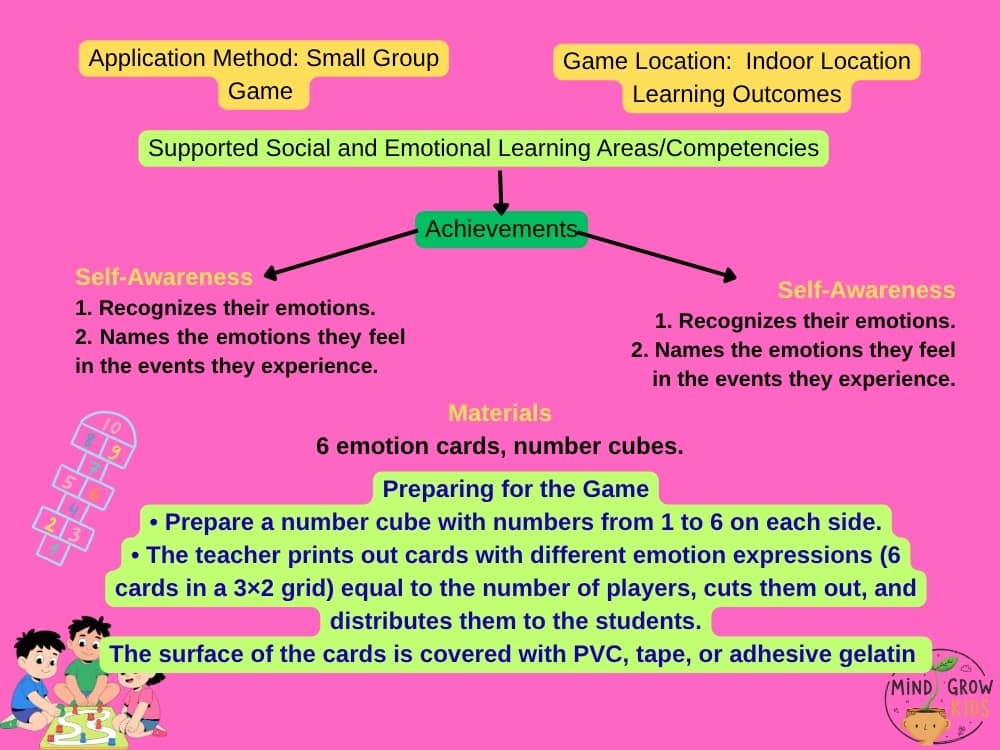
Game Process
- Children gather around a table.
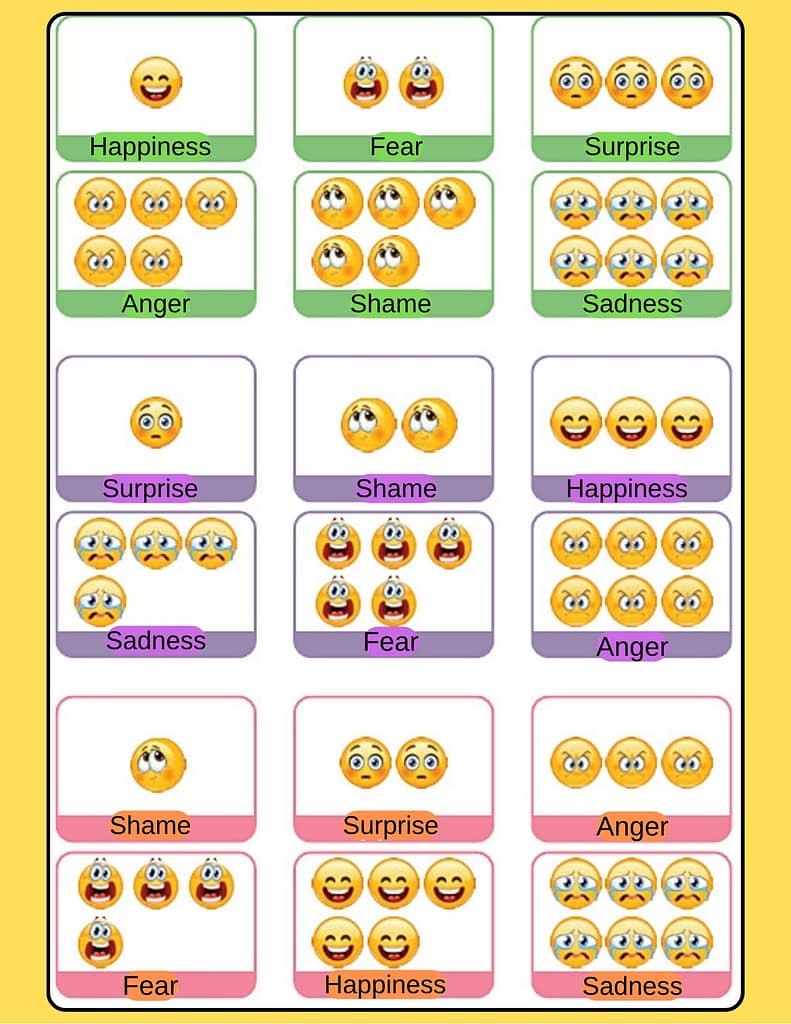
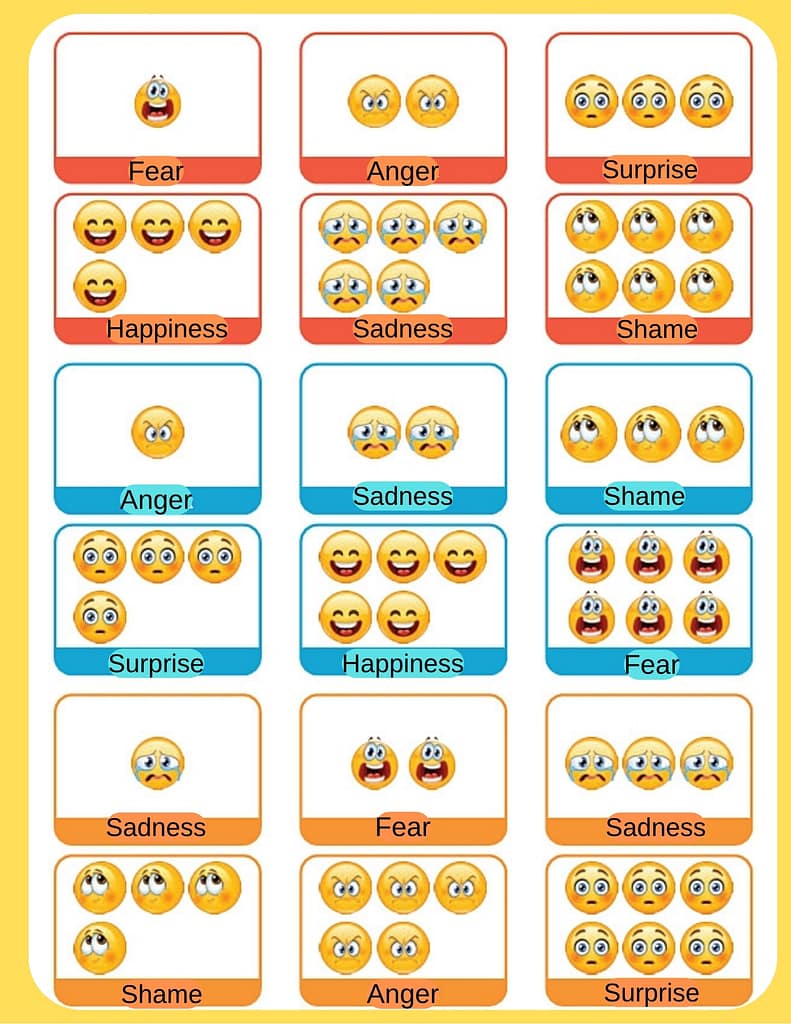
- Each child selects one card from the cards with emotion expressions.
- One child rolls the dice. The number on the dice corresponds to the emotion(s) on the cards in the children’s hands. They mark that card and take turns saying, “My emotion is … (name of emotion).”
- Rolling the dice continues clockwise in turn.
- The same emotion can be marked more than once on the emotion cards.
- Depending on the students’ motivation, the game ends after 3 or 4 rounds.
Evaluation
- The graphic created by the symbols on each child’s card is interpreted.
- Children can be talked about which emotion appears most frequently, which emotion appears least frequently, which emotions appear equally, or which emotion appears the number of times.
Points to Consider/Suggestions - Different emotional expressions can be added depending on the children’s developmental levels.
- The number of boxes on the cards can be increased.
Emotion Cards