
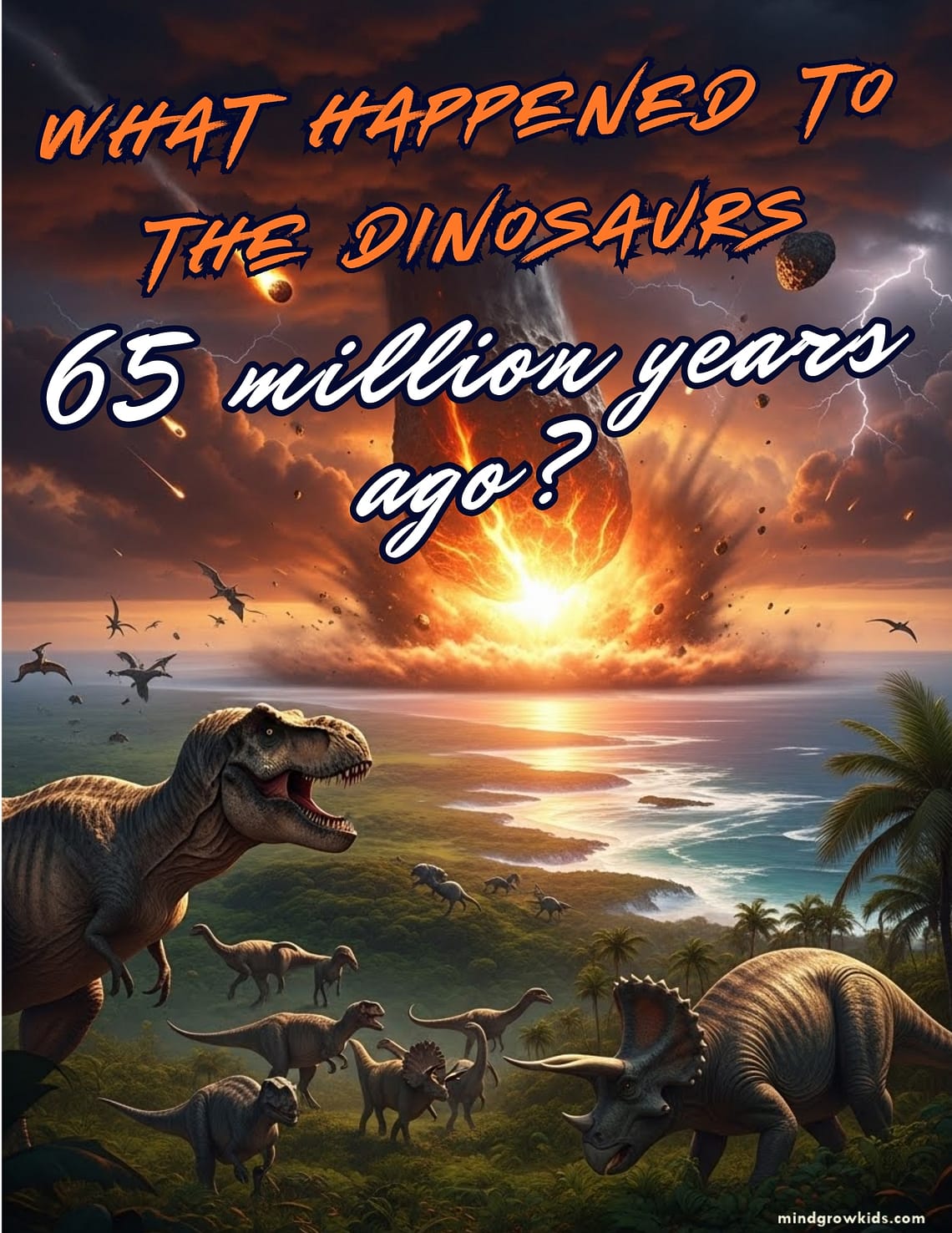
Dinosaurs ruled the Earth for 160 million years. But 65 million years ago, a catastrophe suddenly wiped out these giant reptiles. And it wasn’t just the dinosaurs that disappeared. At that time, most living species went extinct. So, how did such a massive event occur?
Until recently, scientists didn’t know the answer to this question. Now, most believe that two violent natural events may have caused this situation. One of these events was the fall of a meteorite, and the other was a major volcanic eruption. Dinosaurs might have survived one of these. However, it seems that both events occurred simultaneously. The Solar System is often thought of as a simple system consisting of the Sun and planets. However, it also contains countless meteorites. Since they are mostly concentrated in certain regions, they are generally harmless.
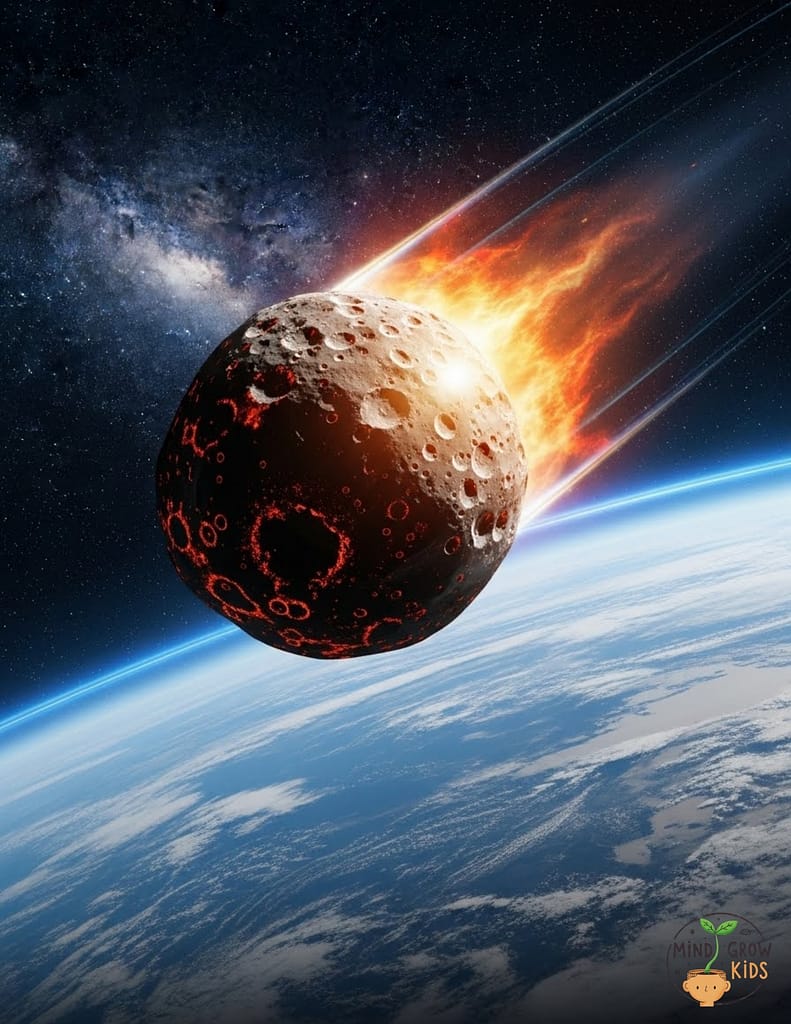
However, some meteoroids may leave these regions for various reasons and settle into different orbits. In fact, many small meteoroids enter our planet’s atmosphere every day and burn up. As a result, the harmless and even entertaining celestial event called a “shooting star,” or, more incorrectly, a “falling star,” occurs. Additionally, a few times a year, meteoroids that don’t completely burn up in the atmosphere fall to Earth. These are mostly about the size of a pebble and therefore don’t cause much damage where they land. However, there is strong evidence that much larger ones have fallen to Earth in the past. One of the best-known examples is the asteroid that fell on the North American continent about 50,000 years ago, which was roughly the size of an apartment building. When this asteroid struck, it produced an amount of explosives equivalent to a thousand atomic bombs the energy released must have been equivalent to the energy that would have been released by the meteorite. Fortunately, no humans lived on this continent at that time. The crater remaining from this collision, which is 1.5 kilometers in diameter, has been very well preserved to this day. The size of this meteorite is insignificant compared to that of 65 million years ago. 65 million years ago, a meteorite the size of Mount Everest pierced the atmosphere and fell near the Gulf of Mexico.
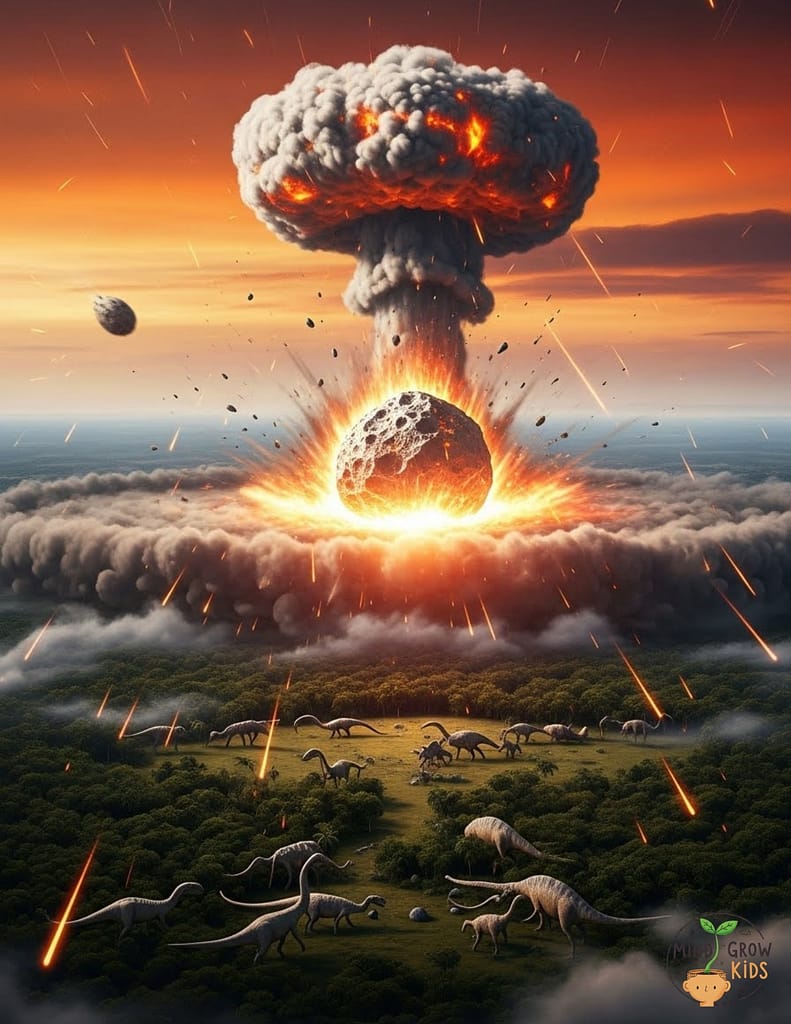
This massive rock exploded in less than a second, creating a crater 200 kilometers wide and 40 kilometers deep. Of course, everything within a radius of hundreds of kilometers around the site of the explosion was instantly destroyed. A fireball of dust, debris, and hot gas swept across North America, obliterating forests and other living things. Hours later, the dust from the explosion covered the North American sky, plunging the continent into pitch darkness. But this was only the beginning. The firestorm created a hole in the atmosphere, sending rock fragments flying into space at great speed. Some of these reached halfway to the Moon. However, the fragments, which had gradually slowed down and then stopped falling due to gravity, entered the atmosphere at the same speed within a few days. This is what caused the global catastrophe. Fragments rained down on the Earth for days. The meteorites entering the atmosphere caused the upper layers of the atmosphere to heat up by hundreds of degrees.
The entire Earth was as if under a giant grid. Therefore, forests burned on all continents. When the smoke from the fires combined with the dust, the sky completely darkened. A few days after the collision, temperatures began to drop because the sun’s rays no longer reached the Earth, and our planet experienced a “collision winter.” The plants that survived the fires this time they died from the lack of cold and light. Even though the dinosaurs somehow survived the heat, they later faced cold and starvation. As if that weren’t enough, chemical substances released into the atmosphere and the resulting acid rain poisoned them.
Another Blow from Underground:
What happened at that time didn’t end with what we’ve described above. Geologists discovered that there was volcanic activity that began 200,000 years before the meteorite impact and ended 300,000 years after it. When considered, the damage a typical volcanic eruption can cause is very small compared to that of a giant meteorite. But this was not an ordinary volcanic activity. In fact, each eruption was hundreds of times more powerful than even the largest volcanic eruption humankind has ever witnessed. Moreover, it is estimated that there were more than a hundred of these volcanoes. Modern volcanoes are generally formed by the eruption of molten rock through a narrow vent. However, the activity 65 million years ago spread across an area hundreds of kilometers wide.
A year later:
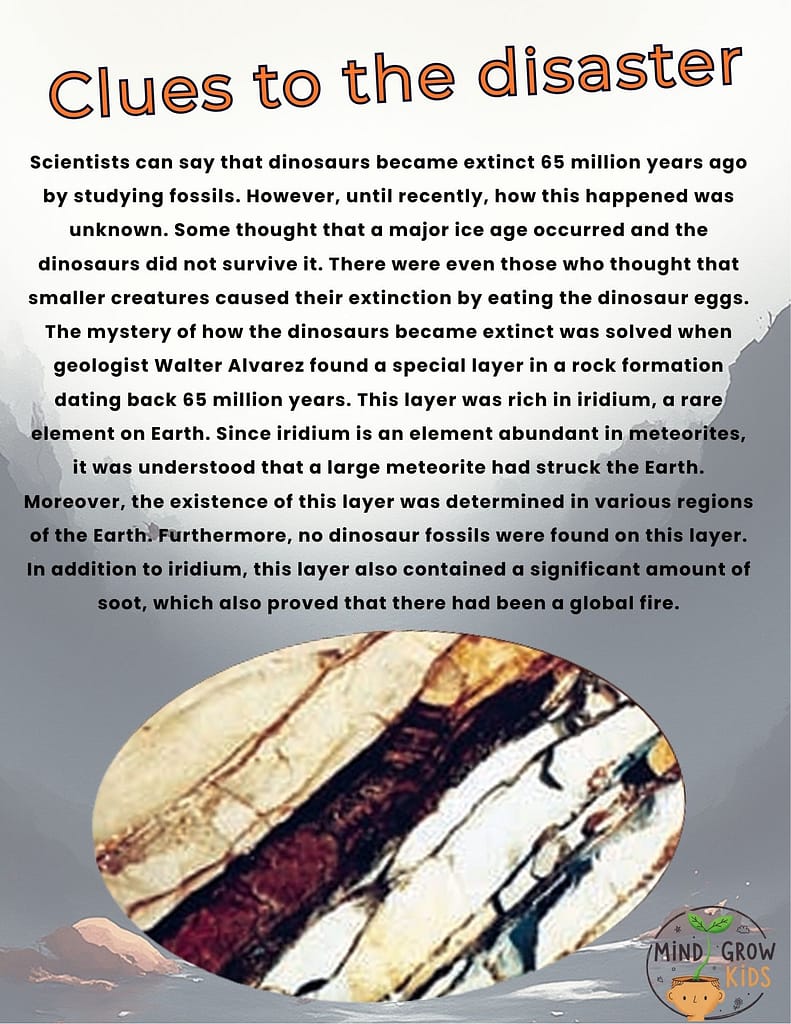
The ash in the sky largely settles to the ground, and the Sun begins to heat the Earth again. Fifty years after the collision: Some plants are beginning to sprout. However, it will take a long time for forests to form. Fifty years after the collision: Some plants are beginning to sprout. However, it will take a long time for forests to form. It was like a mushroom of lava slowly rising to the surface. This lava erupted through cracks hundreds of kilometers long. It took approximately half a million years for all the lava to reach the surface. Of course, a large amount of ash and toxic gases were also released into the atmosphere during the lava eruptions. Scientists believe that this volcanic activity alone would have been enough to affect the entire planet, wiping out numerous plant and animal species. As if that weren’t enough, a meteorite impact during volcanic activity put the final nail in the coffin.
The Return of Life: After all the catastrophes that have occurred on our planet in the past, life would somehow sprout again. However, it took millions of years for life on Earth to recover after these two events. After these events, dinosaurs and many other species became completely extinct. Afterwards, new animal and plant species emerged. Although 90% of mammal species became extinct, this was enough for new species to emerge. Most of these were mammals that could find shelter, living underground, in caves, or in water. Through the evolution of these small mammals, other mammals also emerged over time. The plants that survived were those whose seeds could remain underground for a very long time. According to scientists, if these events hadn’t happened 65 million years ago, giant reptiles like dinosaurs would have dominated the Earth for hundreds of millions of years more. These giant reptiles would have put immense pressure on mammals, preventing them from ever developing and diversifying to this extent. Considering this, if the volcanic activity and meteorite impact hadn’t occurred, dinosaurs would still be alive today, but most likely humans wouldn’t exist.
Sources:
Mackenzie D., What Killed The Dinosaurs, Ask, April 2006 http://www.actionbioscience.org/newfrontiers/eldredge2.html http://www.paleo.gly.bris.ec.uk/Communication/Couch/possible.html