
Research on exoplanets has led to the emergence of a new field called planetary demography. When the characteristics of exoplanets discovered to date are examined, two distinct population deficiencies stand out. Researchers have begun to propose various hypotheses to explain these population deficiencies.
How Ordinary is the Solar System?
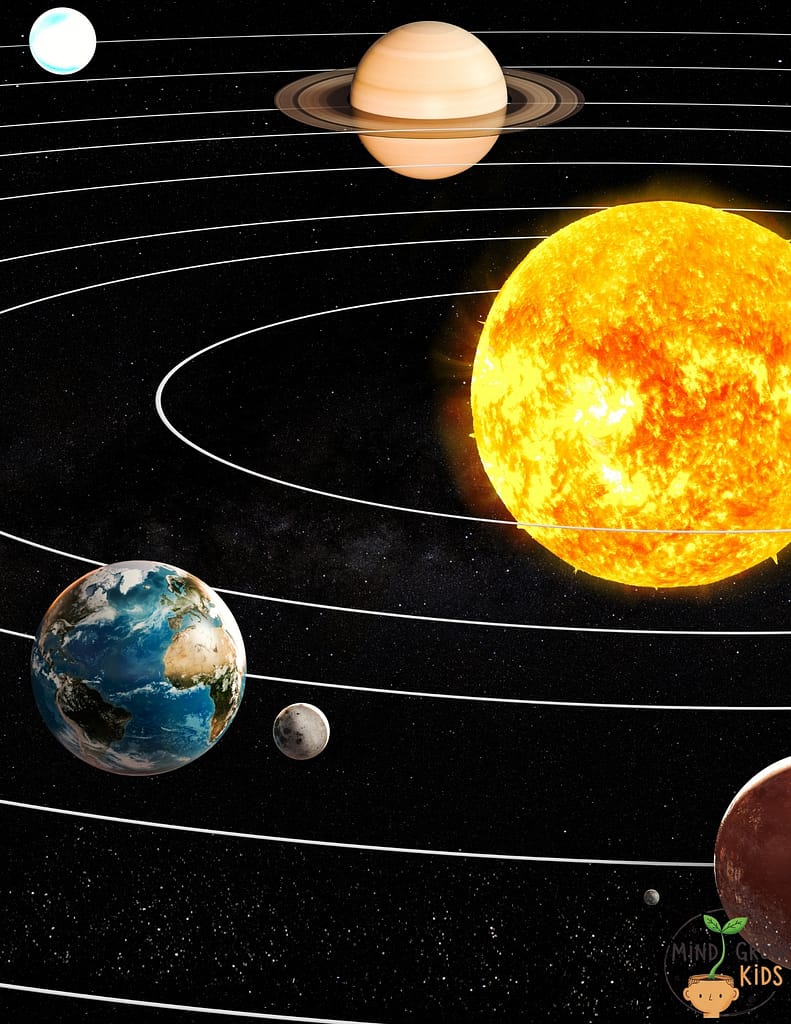
When we look at the planets in the solar system, a distinct order is noticeable. Mercury, Venus, Earth, and Mars, located in the inner part, are small, rocky planets. Jupiter, Uranus, Saturn, and Neptune, located in the outer part, are large and largely composed of gases. One explanation for this order is that the solar system is largely composed of volatile gases such as hydrogen and helium. The amount of elements such as iron, nickel, carbon, and silicon is much smaller. In regions closer to the Sun, where the temperature is higher, volatile gases such as hydrogen and helium move at high speeds. It is difficult for these volatile gases to combine and form the structure of the planets. Therefore, planets that have formed in regions close to the Sun are largely composed of heavier elements such as iron and nickel and have a rocky structure. The reason these planets are relatively small is, naturally, that heavy metals, which are found in their composition, are scarce in the solar system. In regions further from the Sun where the temperature is lower, hydrogen and helium move at lower speeds. It is easier for these volatile gases to combine and form the planets. Therefore, the planets in the outer regions of the solar system are largely composed of gases. These planets The reason they are much larger compared to the planets in the inner region of the solar system is, naturally, that hydrogen and helium, which are in their structure, are abundant in the solar system. Until about thirty years ago, the known planets were limited to those in the solar system. Although the existence of other planets (exoplanets) outside the solar system was expected, no exoplanet had yet been discovered. At that time, the prevailing opinion among astronomers was that if there were other planetary systems, their structure would resemble that of the solar system: small rocky planets orbiting in regions close to the star and gas giants orbiting in regions far from the star.
However, after the discovery of thousands of exoplanets in the last thirty years, this opinion has gradually changed. In fact, current data shows that the structure of the solar system is unusual when compared to planetary systems in the universe. For example Studies conducted to date show that planets classified as super-Earths are abundant in the universe. In fact, research shows that approximately half of sun-like stars have at least one of these planets, which are larger than Earth’s mass but smaller than Neptune’s. However, there are no super-Earth type planets in the solar system. Also, many planetary systems have gas giants orbiting close to their stars, unlike the solar system. However, it should be noted that the methods used today for exoplanet discovery are more successful in discovering certain types of planets, which also has an effect on these results.
Exoplanet Discovery:
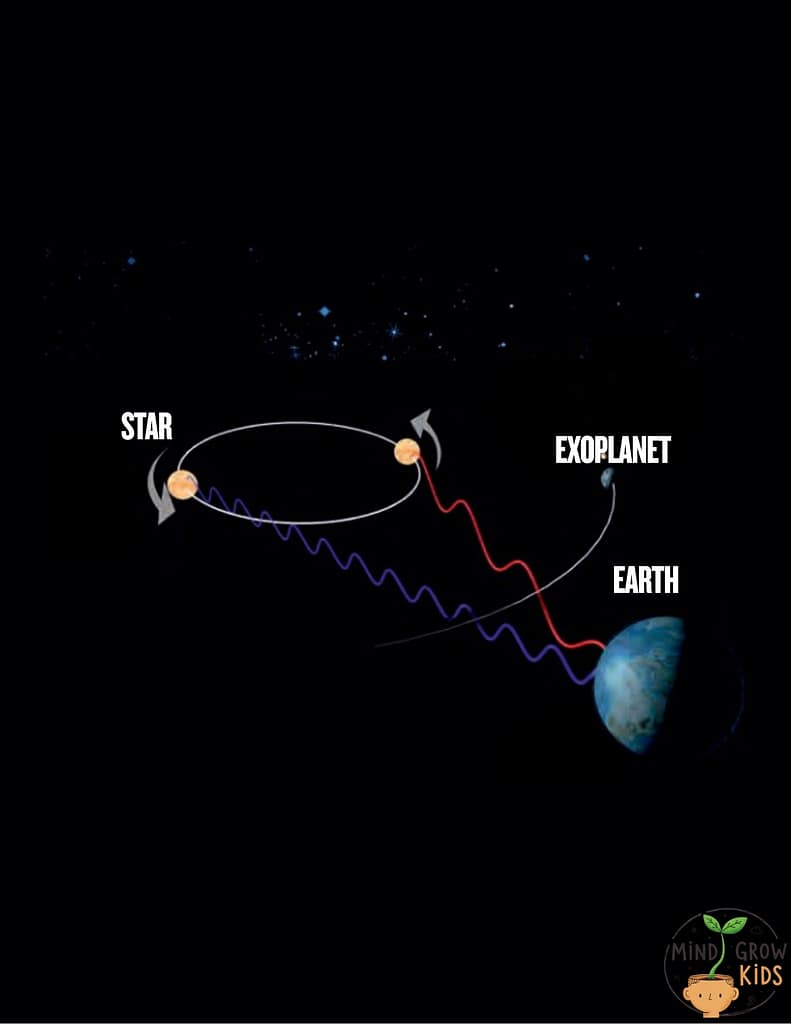
Observing planets outside the solar system is difficult. Because there is always a much larger and much brighter star near exoplanets. This situation makes it difficult to directly observe exoplanets with optical telescopes. Currently, the methods used to discover exoplanets rely on observing stars. Let’s consider a star and a planet orbiting it. The planet moves under the influence of the star’s gravity. However, it’s not just the planet that moves. The planet’s gravity also causes the star to move. In such a system, the star and planet essentially orbit the center of mass. However, since the mass of stars is much larger than that of planets, the center of mass of the system is generally very close to the center of mass of the star. Therefore, the star moves much less than the planet. When such a system is observed from Earth, the star is seen to “wobble” in space. During the wobble motion, the color of the light reaching Earth from the star shifts towards blue or red (the observed frequency of the light increases or decreases) depending on whether the star is approaching or moving away from Earth. By measuring these shifts, inferences can be made about the existence of a planet orbiting the star. The larger the mass of the planet and the closer its orbit to its star, the greater the wobble motion. Therefore, this method, called “radial velocity measurement,” is particularly useful in the discovery of massive planets orbiting close to their stars. The first exoplanet discoveries were made in 1992. The first planet orbiting a sun-like star was detected in 1995. Detected by radial velocity measurement and named 51 Pegasi b, the planet was unlike any planet in the solar system. The planet orbited so close to its star that it completed one orbit in just 4.2 days. As a result of being so close to its star, the planet’s temperature must have been above 1,000°C. Measurements showed that the planet’s mass was half that of Jupiter, and its volume was twice that of Jupiter.
The reason the planet was so bloated relative to its mass was its extremely high temperature. Astronomers now classify 51 Pegasi b-like planets, which are unique in the solar system, as “hot Jupiters.” The existence of hot Jupiters cannot be explained by models inspired by the structure of the solar system, which posit that small rocky planets orbit closer to the star and large gas giants orbit further away. If gas giants like Jupiter can form in orbits close to the star, or form in regions far from the star and migrate towards it over time, this indicates that theories about the formation and development of planetary systems need to be updated and improved. In the following years, studies using the radial velocity measurement method would show that approximately 10% of Sun-like stars have giant planets orbiting at distances of a few AU (AU: Astronomical Unit, the average distance between Earth and the Sun, approximately 150 million kilometers) from their stars. A significant turning point in exoplanet research was the commencement of operations of NASA’s Kepler Space Telescope in 2009. The telescope, specifically designed for exoplanet discovery, observed over one hundred thousand stars in our Milky Way galaxy for four years. Through the analysis of the collected data, thousands of exoplanets were discovered. In research using the Kepler Space Telescope, the transit method was used to discover exoplanets. This method is based on measuring the changes in the amount of light reaching Earth from a star. A planet passing in front of a star causes the light reaching Earth from the star to decrease periodically. By detecting these periodic decreases, both exoplanets can be discovered and information about the characteristics of the planet and its orbit can be obtained. The larger the planet and the closer it orbits its star, the greater the change in the amount of light reaching Earth from the star, and the more frequently the planet will pass in front of its star. Therefore, the transit method, like the radial velocity method, is more effective in discovering large planets orbiting close to their stars. Another interesting piece of information revealed by Kepler data was the finding that super-Earth planets are abundant in our galaxy. Analyses show that approximately half of Sun-like stars have at least one super-Earth planet.
This showed that there were no such planets in the solar system. The absence of such planets also showed that the solar system could not be seen as a template for planetary systems in the Milky Way. Planetary Demography In the last thirty years, a new field called planetary demography has emerged with the discovery of thousands of exoplanets using radial velocity and transit methods. Astronomers are trying to better understand the formation and development processes of planetary systems by studying the sizes, orbits, and compositions of the discovered planets. When the demographics of the planets discovered to date are examined, the absence of two types of populations is noticeable. First, there is a “radius gap” in the data: Among the planets discovered to date, the density of planets with radii between 1.6 and 1.9 times that of Earth is very low. Secondly, a “hot Neptune desert” is noticeable in the data:
Neptune-sized planets are not found in orbits with periods shorter than three days.
Both of these population deficiencies are most likely the result of physical processes that cause planets to lose their atmospheres over time.
A noteworthy point regarding the radius gap is that planets below and above the radius gap have different compositions. Planets below the radius gap are rocky, high-density like Earth; planets above it are classified as “mini-Neptunes,” where a rocky core is surrounded by a dense layer of hydrogen and helium gas. This situation raises questions such as: Do all small planets are born with a large atmosphere and some lose part of their atmosphere later, or do planets are born with different compositions from the beginning? Scientific studies indicate that the correct answer is most likely the former. Recent observations of planets actively losing their atmospheres have shown that gas loss plays a significant role.
Atmospheric Loss Mechanisms:
Several mechanisms are proposed that could prevent the formation of a large atmosphere around planets during their formation, or cause a planet to lose its existing atmosphere over time. Two of these mechanisms stand out: photoevaporation and core-driven mass loss. These mechanisms could explain both the radius gap and the hot Neptune desert. The key factor in the photoevaporation mechanism is radiation emitted from the star around which the planet orbits. Young stars, when they begin to produce energy through fusion reactions, emit high amounts of ultraviolet light, X-rays, and electrically charged particles. This high radiation can allow gases in a planet’s atmosphere to gain enough energy to overcome the gravitational pull binding them to the planet. For example, let’s imagine that there are two separate planets orbiting two similar stars in similar orbits. Let’s say the first planet has a slightly lower mass and the second planet has a slightly higher mass. The planet with the lower mass has weaker gravity.
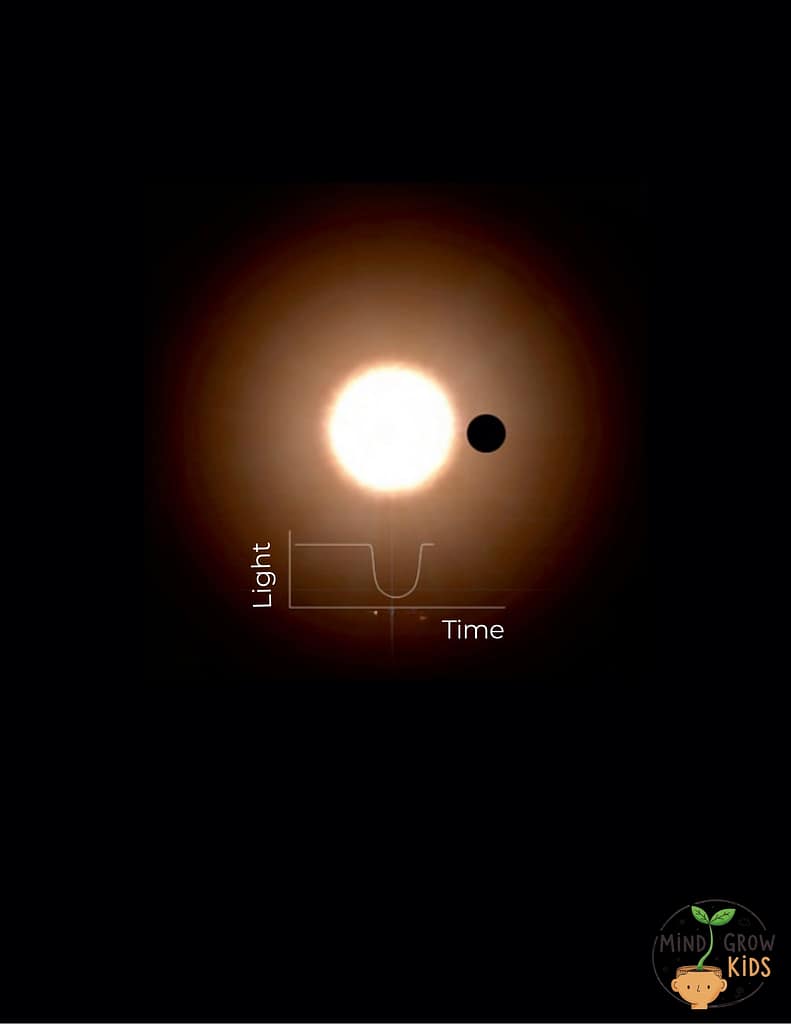
A periodic decrease in the light reaching Earth from a star indicates the presence of a planet orbiting the star.
Because of the high radiation emitted by its star, it cannot protect its atmosphere. As the atmosphere surrounding the planet thins over time, what remains is a rocky planet with a small radius. The massive planet, however, manages to protect its atmosphere because its gravity is strong. It remains a relatively large-radius planet surrounded by a light, swollen atmosphere.
The explanation that the photoevaporation mechanism provides for atmospheric loss is also consistent with various observational data. For example, photoevaporation should be more in regions closer to the star and less in regions further away. Therefore, the upper limit of the radius gap is expected to shift towards lower values as it moves away from the star. Observations also confirm this prediction. The reason for the existence of the hot Neptune desert is that photoevaporation is more effective in orbits close to the star where the orbital period is only a few days. Only planets with rocky cores or very massive planets like Jupiter can survive in these hot orbits. Planets with a mass similar to Neptune’s and composed of volatile gases cannot exist in these hot orbits. The main factor in the core-driven mass loss mechanism is the heat emitted from the planet itself. During planet formation, the inward collapse of mass releases heat. This heat causes the gases surrounding the planet to expand and rise, making it easier for them to escape the planet’s gravity. This mechanism is more effective for low-mass planets. Massive planets, thanks to their strong gravity, do not experience significant atmospheric loss through this mechanism. There is no consensus among astronomers on which of these two main mechanisms is more dominant. Probably one or the other of different mechanisms is more effective, depending on the conditions that vary from planet to planet. Besides photoevaporation and core-driven mass loss, various other mechanisms are proposed regarding how planets lose atmosphere. For example, young planets in the formation stage collisions between them could lead to atmospheric loss.
A hypothesis called the rapid evaporation theory suggests that shortly after a planet’s formation is complete, the dispersal of the material accretions orbiting the star in which the planet was born causes the pressure around the planet to rapidly decrease, resulting in the escape of gases from the atmosphere into space. Finally, the reason a planet has a small atmosphere may be due to the low amount of gas in the environment in which it formed.
Observations
Since atmospheric loss occurs mostly in the early stages of planet formation, it is not easy to detect significant atmospheric loss by observing small planets.
The most prominent alternative for observing atmospheric loss is hot Jupiters. It is relatively easier to observe the gases emitted into space from these gas giants orbiting very close to their stars in real time. By analyzing the hydrogen and helium spectrum in the light reaching Earth before, during, and after a transit from a star orbiting a hot Jupiter-type planet, data on ongoing atmospheric loss can be collected. Hot Jupiters experiencing atmospheric loss have been observed in recent years. For example, various research groups have detected that the planet WASP-69 b is actively losing its atmosphere. This planet, with a radius similar to Jupiter’s and a mass similar to Saturn’s, completes one orbit around its star in approximately 3.8 days. According to a study published last year, WASP-96 b is losing 200,000 tons of mass every second. In other words, this means that WASP-96 b’s mass will decrease by approximately the same amount as Earth’s in a billion years. Observations show that there are also time-dependent changes in the shape of the gas escaping from the planet into space. Sometimes the length of the gas cloud emanating from the planet exceeds 500,000 kilometers and takes on a shape similar to the tail of comets. Sometimes the gas flow is much less pronounced. Researchers attribute these changes to changes in the star’s activity. Research on planetary demographics is expected to accelerate in the coming years. It is thought that the formation and development of planetary systems will be better understood, especially with the commissioning of new generation telescopes that will enable better determination of the masses, compositions, and atmospheres of planets. For example, as a result of these studies, important information can be obtained about how the type, structure, and composition of the planets around the star change depending on the type of star. These studies will not only be limited to planetary demographics, but will also provide insights into life in space.
Summary
Before exoplanets began to be discovered, it was thought that if there were any, planetary systems around other stars would resemble our own system. However, scientific studies show that the solar system cannot be seen as a template for planetary systems. After thousands of exoplanets were discovered in recent years, a new field called planetary demography was born. Astronomers are trying to better understand the life cycle of planetary systems by studying the type, structure, and composition of the discovered exoplanets and the stars around which these planets orbit. There are noteworthy points about planetary demography. Planets with radii 1.6 to 1.9 times that of Earth are rarely encountered. Also, Neptune-like planets are not found in orbits with periods on the scale of a few days. Scientific studies indicate that this radius gap and the hot Neptune desert are related to the loss of atmosphere in planets. There is a minimum mass at which a planet can retain its atmosphere for a given orbital radius. The radius gap separates planets with masses large enough to retain their atmosphere from those with masses too small to retain their atmosphere. The hot Neptune desert shows how difficult it is for a planet to retain its atmosphere in orbits very close to its star. Only planets with masses as large as Jupiter’s can retain their atmosphere in orbits with periods of a few days where the radiation emitted from the star is extremely high. Neptune-like, lower-mass gas giants cannot exist in these orbits.
Source
Tyler, Dakotah, “Where are the Universe’s Missing Planets?”, Scientific American, https://www.scientificamerican.com/article/exoplanet-census-identifies-missing-planets-gap/, 2025