
Author: Emma Hubbard
“How many times do I have to say it?” “Can’t you hear me?” Do these phrases sound familiar? If you’re tired of raising your voice after your child leaves the room and repeating the same thing over and over, you’re not alone.
The point isn’t to find harsher discipline methods. Your child’s brain doesn’t work like we do as adults. The way to reach them is to use language appropriate for this tiny, developing brain.
As a pediatric occupational therapist, I’ve worked with hundreds of families and have seen that the right approach makes an incredible difference. Drawing on my experience, these 5 simple steps can help your child develop the habit of listening to you the first time, even within days. It’s not magic; it’s just a humane method that works.
Here are 5 steps to end power struggles:
Step 1: Contact, Then Instruction
While your child is engrossed in their tablet or playing a game, their mind is like wearing the best headphones. Your voice is just background noise. Has your spouse ever said something to you while you were looking at your phone, but you didn’t hear a thing? Your child is always in this situation.
The way to get that headset off is through physical contact:
Go to them, don’t call from afar.
Lean down to get them at eye level. Talking over them can frighten them and trigger their fight-or-flight response.
Touch their arm or shoulder gently. This touch is a key to directing their attention to you.
Just say their name and wait for them to look up. That eye contact is a signal, “Okay, I can hear you now.”
Only after you’ve established that connection, tell them what you want them to do.
Step 2: Speak to Their Mental Capacity
Here’s the trap we most often fall into: “Go pick up your toys, put on your shoes, grab your bag, and get in the car!” This set of instructions, clear to us, is like an incomprehensible wall to a child.
Think of a child’s working memory like a small blackboard. Ours is big, theirs is tiny. When you give them a long list, it fills up instantly. The outcome can be one of two: They either do some of what you say (forgetting the rest) or they don’t do anything (because they’re depressed).
- To adapt to this little “blackboard”:
- Speak according to their age:
- 18 months: One step (“Get the ball”).
- 2 years: Two connected steps (“Get the ball and put it in the basket”).
- 3 years: Two unconnected steps (“Give me the teddy bear and then get the ball”).
- 5 years: Three unconnected steps (“Put the ball in the box, get your shoes, and come to the door”).
- Be brief and clear: Instead of saying “Get your stuff together,” say “Put the Legos in the box.”
Tell them what to do: Instead of saying “Don’t run,” say “We’re walking inside.” Instead of “Don’t climb on the table,” say “Keep your feet on the floor.”
Step 3: Count Silently to 10
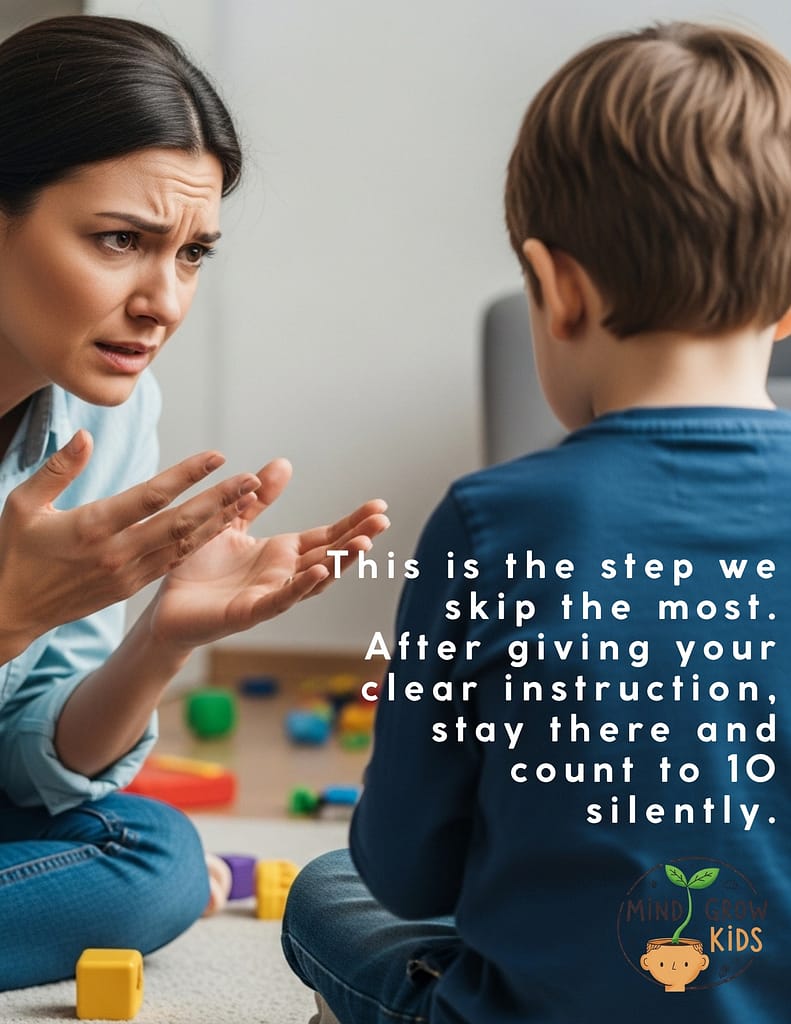
This is the step we skip the most. After giving your clear instruction, stay there and count to 10 silently.
This quiet moment is crucial. Your child’s brain needs to process the words they hear, understand their meaning, plan how to perform the action, and send the “move” command to their body. Research shows this process takes about 7-10 seconds. By giving them this time, you allow their brain to catch up.
Step 4: Exaggerate and Clarify the Praise
After the 10-second wait, one of two things will happen. If your child does what you told them to do, praise them right away.
Instead of a general “Great job,” tell them exactly what they did well: “Wow, you picked up all the Legos! You’re awesome!” or “I love that you put on your own shoes!”
This clear praise will help them understand exactly what they did right, make them feel genuine pride, and want to repeat that behavior. It also teaches him: “Listening the first time means getting positive attention from Mom/Dad.”
Step 5: Physical Guidance
Another possibility is that he won’t do what you say. Our goal here is to teach him that we meant what we said the first time. It’s time to help him and complete the action together.
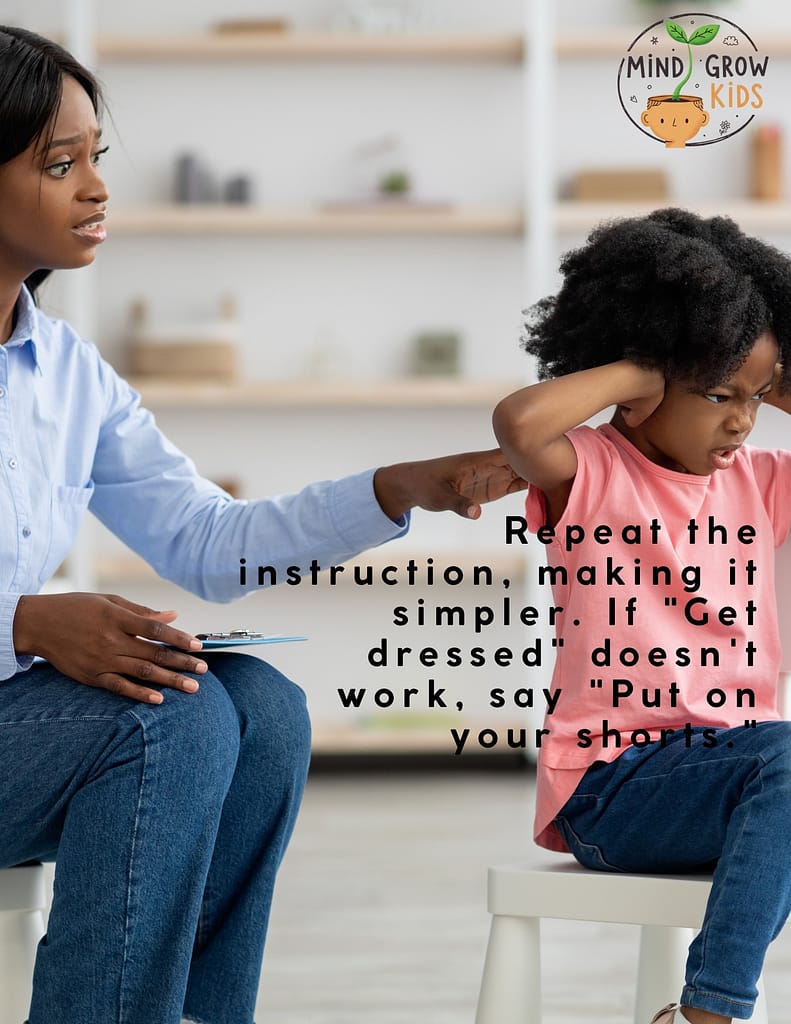
Repeat the instruction, making it simpler. If “Get dressed” doesn’t work, say “Put on your shorts.”
If he still doesn’t move, physically guide him. Continuing with the dressing example:
Point to the chair and say, “Sit here.”
Hand him the shorts and say, “Take your shorts.”
Tell him, “Put on your shorts now,” and guide his legs if necessary.
Praise his efforts as he completes each step, even with help.
This isn’t about doing the work for him, but about teaching him that “listen and complete” is non-negotiable. Over time, you’ll find he needs you less and starts listening the first time.
One Final Note: Let People Be. Remember, they’re little people, just like us. Sometimes they’re not in the mood, sometimes they don’t want to cooperate. This is normal and doesn’t mean you’re a failure. This five-step method, when applied with patience and understanding, can transform not only your child’s listening habits but the dynamic of your entire relationship. It can help you shift from a cycle of frustration to one of connection and cooperation.