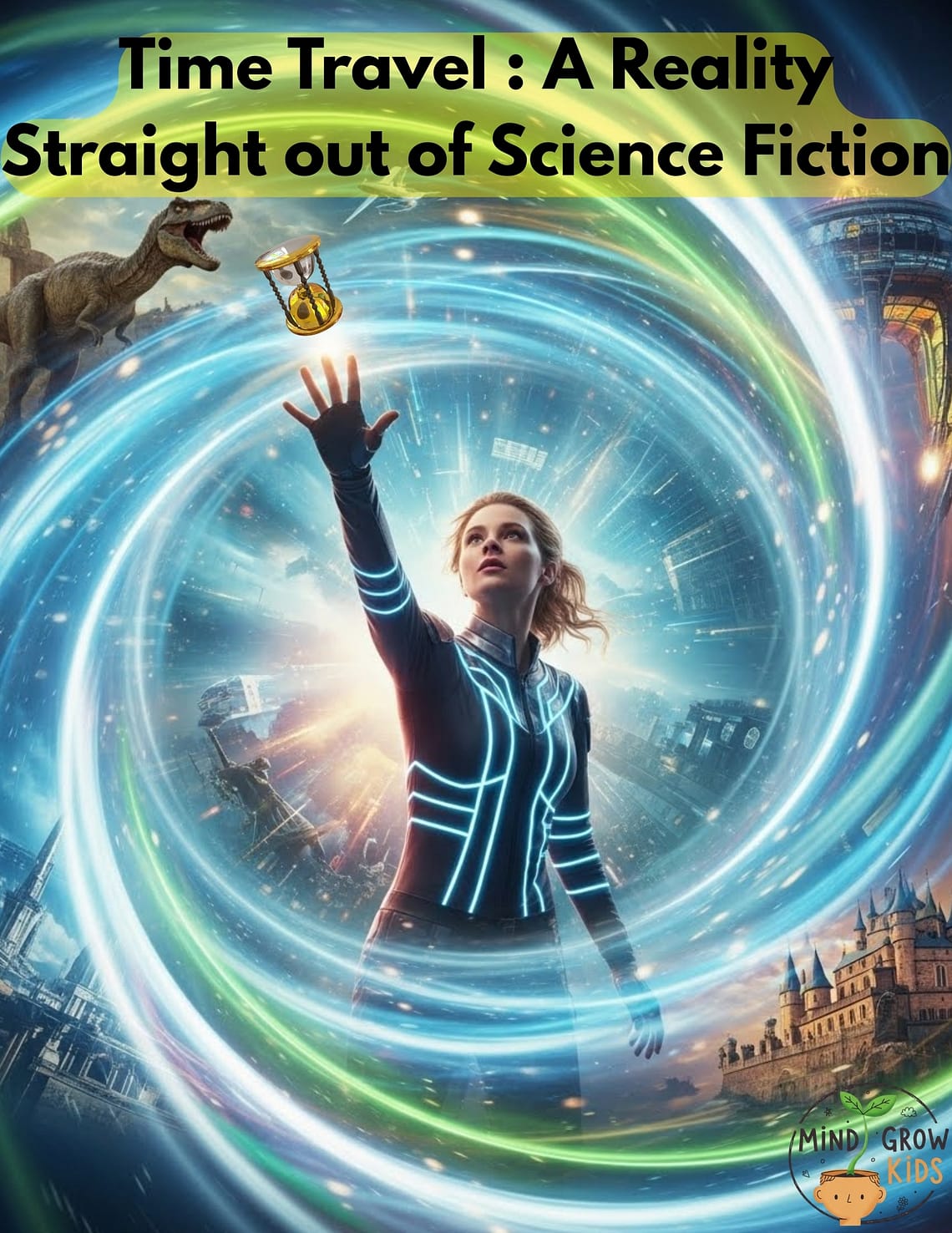
Time is like a river that carries us from birth to death, a river in whose flow we surrender ourselves.
As we perceive it, time is something that flows from the past to the future, something we somehow feel or know exists. But should we accept the fact that time is truly an irresistible part of life? Or can we slow it down? More importantly, can we go to the future or the past? Can we travel through time?
Who wouldn’t want to jump into a time machine and go back in time to change things? Time travel is one of the familiar themes of science fiction. Like many things that once existed in science fiction but have now become a reality, could a time machine one day become a reality? “The Time Machine” was H.G. Wells’ first novel. Since Wells wrote this novel in 1885, “time travel” has become one of the fundamental elements of science fiction. After that, the idea of time travel became a topic of discussion not only for science fiction novelists and screenwriters, but also for scientists. Wells was not only one of the most important writers of English literature with his art, but he also thought more broadly than even the scientists of his time with his scientific approaches.
Ten years before Einstein said that we should consider the universe as four-dimensional space-time, Wells put forward the idea of considering time as the fourth dimension. Although the days when we can jump into a time machine and go to any time we want do not seem very near, time travel seems possible in some way. In fact, we do it without realizing it even today. For example, those who travel constantly by air age a little slower than those who stay on the ground. For now, it is not possible to go to the past by pulling a lever, as in Wells’ time machine. However, scientists suggest that there are other ways to travel to the past.

The Arrow of Time
Newton was undoubtedly one of the most important scientists of his time in mathematics and physics. However, during his time and for two centuries afterward, the concept of time travel never came up. In his masterpiece Principia, Newton gives the following definition of time: “Time, being a definite, real and mathematical fact, flows by its very nature, unchanged, unaffected by external influences.” Is that really the case?
Our senses tell us that the universe we live in is three-dimensional. All the objects we see and feel are three-dimensional. Developments in theoretical physics, however, show that the universe is not limited to three dimensions. At the beginning of the 20th century In the past, following Einstein’s theory of general relativity, the number of dimensions began to increase. Today, many serious theories suggest more than 10 dimensions. Time, besides the three dimensions we are accustomed to, is the easiest for us to understand. Thanks to the experiences we gain from daily life, we can define the past, present, and future. The past is behind us; it never comes back and cannot be changed. The present is the moment we are already living; it becomes the past immediately after it is lived. The future has not yet happened; anything can happen in the future. We can predict some of what might happen in the future. We can change the course of some events with the decisions we made in the past or present, with what we have done.
We can look at time in two different ways. Just as we define an object with its width, length, and height, we can think of time as a coordinate. Or, we can think of it as a phenomenon that flows, that brings the future when it occurs.
When we think of time as a coordinate, things get complicated. For example, Einstein’s theory of relativity suggests that time is “personal.”
Time can be perceived differently depending on the observer; it can flow at different speeds for different observers in two different environments. Special and general relativity briefly show that the impression that time flows in the same way under all conditions is wrong. There is also the issue of the “arrow” of time.
It is clearly evident that time flows from the past to the future. However, the laws of physics are symmetrical with respect to time. That is, these laws work in the same way in backward-flowing time as they do in forward-flowing time.
Newton’s laws, the most famous equations in physics and mathematics, Maxwell’s and Hamilton’s equations, Einstein’s general theory of relativity, Dirac’s and Schrödinger’s equations in modern physics are all symmetrical with respect to time. That is, if we could reverse the arrow of time to point in the opposite direction, they would all work.
If time is a coordinate, why can’t we move in two directions at once?
It seems very contradictory when applied to daily life. Raindrops rising from the ground to the sky, broken pieces of glass coming together to form a glass. These are things we can only see if we watch a film in reverse.

The Gemini Paradox
One of the easiest ways to travel to the future seems to be to hop on a fast-moving rocket, take a short trip, and then return. If your spaceship is fast enough, if it can take you close to the speed of light, the theory of relativity says you will age more slowly than your twin who remained on Earth. In other words, your twin on Earth sees your clock running slower. Since it’s relativity, your twin on Earth is also moving away at the same speed relative to you. You also see that their clock is running slower than yours by the same amount. So, they also seem to be aging more slowly than you. Herein lies the contradiction. One of the twins must be right and the other wrong. There is something to note here: Your twin on Earth is not changing his position. Therefore, it is unlikely that there will be any error in his observations. When we look at the twin traveling in the rocket, since he travels at a constant speed for most of the journey, he might think that he is stationary and that the Earth is rapidly moving away from him. Although this is a correct observation, there is a factor to consider: acceleration. In order for the twin in the rocket to reach a speed close to the speed of light, he needs to accelerate his rocket. The acceleration that occurs during this process creates an effect similar to gravity.
Moreover, these decelerations and accelerations occur both during takeoff and landing from Earth, and also while slowing down and stopping at its destination, and then accelerating back towards Earth.
This is where general relativity comes into play. From the perspective of the twin in the rocket, events unfold as follows: During the constant-speed portion of the journey, his twin on Earth ages more slowly. During the accelerated motion, the opposite happens; he ages more slowly. When the journey ends, the twin in the rocket sees that his brother, whom he left behind on Earth, is older than him. When general relativity is taken into account, there is no longer a contradiction. The time slowing caused by accelerated motion outweighs the time slowing caused by constant speed. General relativity, in a way, closes the gap left by special relativity here.
If we return to the laws of physics, there is a law that describes this situation: The second law of thermodynamics. This law states that in insulated environments, heat always flows from hot to cold. Another requirement of this law, that every event occurring in the universe moves from order to disorder, is expressed as the continuous increase of a quantity called “entropy”. Entropy is a measure of disorder. Accordingly, a glass sitting on the table has lower entropy than a glass that has fallen to the floor and broken. Entropy, in a way, seems to convey a message of hopelessness. Because the order of the system is irreversibly and constantly tending towards decay. Entropy explains why the arrow of time always points forward. When the glass falls from the table to the floor, the pieces of the broken glass scatter throughout the room. We are not surprised by this situation, because many of us have encountered a similar event in daily life and the results have always been the same. If time were reversed, we would see the glass pieces gathering, fusing together to form a glass, and then bouncing onto the table. In fact, there is nothing against the laws of physics in this. Perhaps the following question might come to mind: Where does the energy that makes this glass form come from? The first law of thermodynamics explains this: Energy is conserved. The energy released when the glass falls and breaks is equal to the energy required to put it back together and make it bounce onto the table. Although mathematically and physically, it seems possible for time to reverse, as far as we can observe, the way time works in the universe we live in is not symmetrical. In our universe, life is based on thermodynamic equilibrium. Therefore, it seems impossible for us to observe and live in a universe with time symmetry. This shows that we cannot travel through time by stopping time and reliving events in reverse, as if showing a film in reverse. However, even with the available means, we can slow down time, and we know that by using this and with a little trickery, time travel might be possible. After Einstein…
The definition of time changed with Einstein. Einstein argued that time, contrary to what was thought, is relative. In 1905, he made two assumptions as a result of the theory of special relativity: The first was that the laws of physics are the same for every observer moving at a constant speed; the second was that, under the same conditions, the speed of light is the same for every observer. For these conditions to be met simultaneously, time must flow at different speeds for different observers. We can measure the effects of this today. For example, when we get off the plane after a transatlantic flight, we are 10 nanoseconds faster than those we left behind.
We would become younger by (one hundred millionth of a second). Such small changes do not lead to a noticeable change in our lives. If we had boarded a spaceship instead of a plane and traveled for a few years at a speed close to the speed of light, when we returned home, decades would have passed. Thus, we would not only have gone back and forth to another star system, but we would have also traveled decades into the future.
Although this future travel scenario seems crazy, it can be proven both theoretically and experimentally. In 1971, Joe Hafele (University of Washington) and Richard Keating (US Naval Observatory), wanting to test the theory of special relativity, borrowed four atomic clocks from the Naval Observatory and used them to fly planes around the Earth. Although the planes were slower than a millionth of the speed of light, they were slightly behind the clocks at the observatory. The amount of this delay was exactly as the theory of special relativity predicted. Experiments with subatomic particles called “muons” provide even better evidence. These particles can remain unchanged in the laboratory for only a few millionths of a second. Muons are formed when high-energy particles collide with molecules in our planet’s atmosphere, traveling at speeds close to the speed of light. If the muons were to decay during this time, they would only travel about one kilometer. However, muons that can travel approximately 20 km without decaying and reach the Earth’s surface can be observed.
Einstein and Gravity
strong gravity.
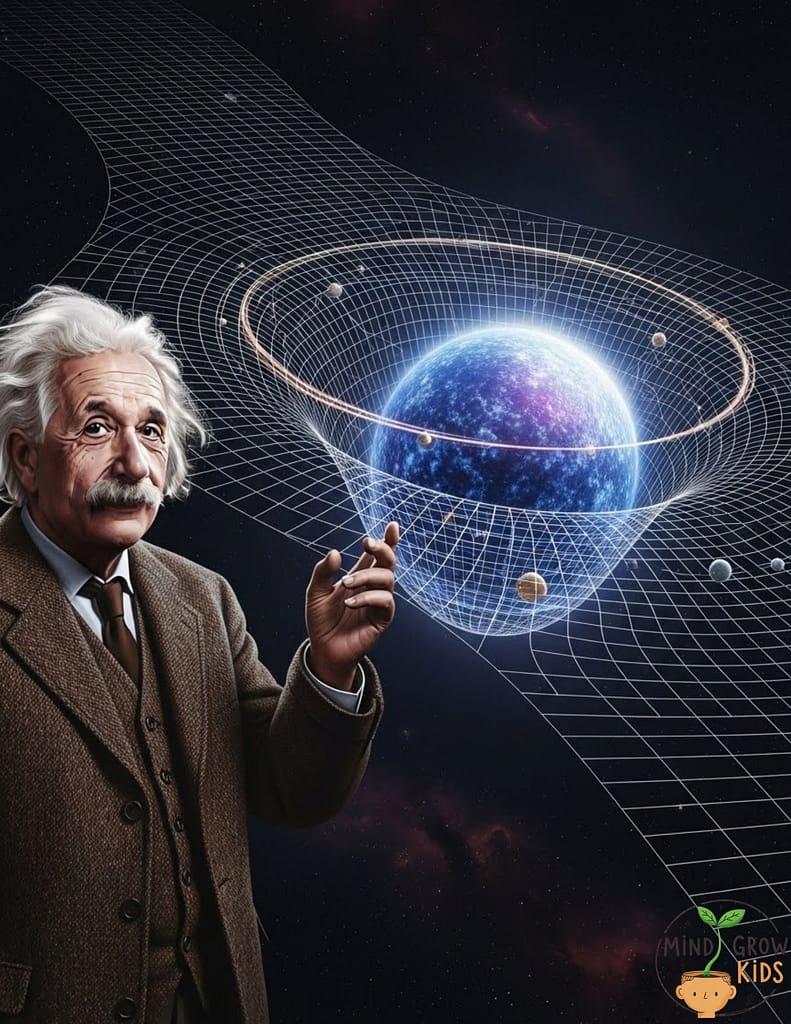
Just as speed is one method of traveling to the future, gravity is another. Ten years after proposing the special theory of relativity, Einstein developed the general theory of relativity. By considering this theory in all directions, he showed that gravity causes curvature in space-time. This stated that as gravity increases, time slows down. Thus, general relativity offered us another tool for time travel:
strong gravity. How can special relativity be proven with various experiments and what are its results?
If special relativity can be observed on Earth, then the effects of general relativity can also be observed on Earth. The Global Positioning System (GPS) is a system of 24 satellites, each carrying an atomic clock. These satellites orbit approximately 23,000 km above the Earth. A GPS receiver determines our distance from the satellite by measuring how long it takes for the signals sent by the satellites to reach us. In the Global Positioning System, both types of relativity are at work. Special relativity states that the clocks on the satellites run slower than those on Earth. This is because the satellites have a certain speed relative to the Earth. The effect of general relativity is the opposite. The strength of the gravitational force originating from our planet is lower in orbit than on Earth. Therefore, atomic clocks on satellites appear to run faster than they actually do, according to observers on Earth. Both of these factors are taken into account for the system to function accurately. The effect of general relativity on time is proportional to the strength of the gravitational field. If we could travel to a neutron star, which is only a few kilometers in diameter but has several solar masses, we would witness that time flows a quarter slower than on Earth. Black holes can be much better time machines. By driving your spaceship near the event horizon of a black hole, you can slow down time to any degree you want. We can think of the event horizon as a region surrounding the black hole. Nothing that falls into it can escape. The gravity at the event horizon only allows an object traveling at the speed of light – which is impossible – to escape. Once the event horizon is crossed, since it is impossible to move faster than the speed of light, escaping becomes impossible. Time stops at the event horizon. This is where the name event horizon comes from: a distant observer sees what is happening at the event horizon as stopped. Many known black holes are found in binary systems. This is because one of the two collapses into a black hole at the end of its life and steals matter from its partner. When matter flows into a black hole, the matter falling into it accelerates by rotating around it, and as the matter approaches the speed of light, it begins to emit strong radiation. In this way, we can understand that there is a black hole there. This radiation around the black hole is X-ray radiation, a very high-energy type of radiation, and no living thing can withstand it. Although they are good time machines, getting this close to a black hole is therefore not a very recommended thing! Not every black hole emits radiation in this way.
However, as you approach the event horizon of a black hole, the gravity on your feet becomes much greater than on your head. Assuming we could stay in one piece, this huge gravitational difference would cause us to stretch out like spaghetti. For a time traveler, the best time machine might be a supermassive black hole. These monsters are usually found at the centers of galaxies. The mass of these black holes can be billions of solar masses, and their event horizon can reach the diameter of the Solar System their diameter is very Because it is so large, the gravitational difference between an astronaut’s feet and head would be smaller, and the astronaut could approach the event horizon without being torn apart. However, a time traveler might not want to cross the event horizon. If the astronaut manages to pass through the black hole, they might find themselves in a completely different universe. Time Travel For now, time travel seems like a journey into the future. One day, astronauts might actually travel in very fast spaceships or fly near a neutron star, making time flow much slower for them. Thus, they would have traveled to the future. Although time travel to the future seems possible, many of us would undoubtedly wish to travel to the past. Moving in the opposite direction of time is a much more complex situation than moving forward. The Austrian mathematician Kurt Gödel had already suggested in 1949 that time travel to the past might be possible. Working at the Princeton Institute for Advanced Study, where Einstein also worked for a time, Gödel envisioned a rotating universe based on the laws of general relativity. Theoretically, an astronaut traveling in such a universe could go to their past. However, Gödel’s discovery was not enough to make time travel to the past realistic. Because we do not have any data indicating that the universe is rotating. In fact, observations show that the universe is not rotating. However, Gödel’s discovery had an important aspect:
it made time travel possible.
In 1974, physicist Frank Tipler (Tulane University, USA) proved that an infinitely long cylinder rotating at near the speed of light could perform the same function. Astronauts orbiting this circle could travel to their past. However, it is impossible to turn this into a time machine. Because it is not possible to make an infinitely long object. Wormholes Another idea offers more hope for time travel. In 1935, Einstein and his colleague Nathan Rosen realized that general relativity allowed the creation of “bridges” in space-time.
These space-time tunnels, known as “Einstein-Rosen bridges,” are now called “wormholes.” These tunnels create shortcuts in space-time, connecting distant points. This allows one to travel from one place to another in a very short time by passing through a wormhole. Even light traveling the normal path cannot cover this distance as quickly as a time traveler. Wormholes are not exactly easy-to-use time machines. Theorists suggest that wormholes may only exist for a moment before turning into black holes. However, although it sounds like a “science fiction” story, some believe that wormholes have a way of preserving their existence.
In the 1980s, Carl Sagan began writing his novel Contact. In the novel, the protagonist, Ellie Arroway, receives a signal from near the star Vega. The coded message in this signal contains instructions for building a machine that will take her to a planet deep within the galaxy. While writing the novel, Sagan considered the possibility that Ellie might fall into a black hole on Earth and emerge on a planet near Vega. To find out if this was plausible, Sagan consulted his friend Kip Thorne, a black hole expert at Caltech (California Institute of Technology). Thorne thinks that using a wormhole would be more suitable than a black hole for this. However, wormholes also have their own problems. The main problem is that wormholes tend to collapse. Thorne and his colleagues work to find out how this can be prevented. They find that this can only be achieved by an effect that can create enough pressure to prevent the collapse. A type of matter called “exotic matter,” which can produce enough pressure to stop the collapse of a neutron star, might be able to do this. Whether this matter exists or not is currently unknown. However, its existence does not contradict the laws of physics.
Grandfather Paradox:
One of the biggest problems we might encounter when time travel is the cause-and-effect relationship. Can the cause come after the effect? One of the best examples of this is the grandfather paradox. Imagine you travel to the past, to your grandfather’s youth. What happens if you accidentally kill your grandmother before you’ve even met her? In that case, your father would never have been born; and of course, neither would you. If you never existed, how could you have caused your grandfather’s death by going back in time? Physicists propose a few rules to overcome this contradiction. First, time travelers cannot interact with the past. Travelers to the past can observe it, but they cannot influence it. Igor Novikov from the University of Copenhagen and Kip Thorne and their colleagues from Caltech have found another way out. According to Novikov’s stability hypothesis, physics is inherently stable and does not allow for paradoxes. According to this view, you can go back in time, interact with the past; however, you cannot create a paradox. In other words, you can go out to dinner with your grandfather; but you cannot kill him. The famous physicist Stephen Hawking from Cambridge University took this idea a step further and proposed the “Chronology Preservation Hypothesis“. According to Hawking, there are physical laws that prevent large-scale objects from traveling through time and that we have not yet discovered. There are more solid grounds behind the majority who are eager to travel to the past. Quantum mechanics, an integral part of physics that explains the behavior of molecules, atoms, and subatomic particles, is optimistic about this. Heisenberg’s “uncertainty theory” plays an important role in this. According to uncertainty theory, an observer cannot simultaneously measure both the position and momentum (the product of velocity and mass) of a particle. This is why the equations in quantum mechanics can only tell you, as a probability, where you might find the particle. When this is applied to time travel, an interesting result emerges.
When a decision is made or a new observation is made, the universe branches out. If this is true, a time traveler could go back in time and accidentally cause their grandfather’s death. Meanwhile, in another universe that is created, the grandfather would be alive and give life to the time traveler’s mother and themselves. Thus, you would be living in another universe in the future.
How to Build a Time Machine?
Thorne and his colleagues, while working with wormholes, discovered that a time machine could be built from them. The trick here is to place one end of the wormhole in a location that leads to the future. For example, bringing a large asteroid near one end of the wormhole might work. While gravity holds the two together, the asteroid needs to be accelerated to near the speed of light. The clock at this end of the wormhole will be ticking much slower than at the other end. You can keep the motion going until you get the time interval you want. You can pull the wormhole out and then bring it back. Your time machine is ready. If you enter one end of the wormhole and exit the other, you go back 10 years in time; if you do the opposite, you go forward. If you want to use gravity instead of speed, a very dense and massive celestial body will do the job. A neutron star is perfect for this. You can bring one end of the wormhole next to a neutron star and wait until you create the time difference you need. Then, you can bring this end next to the other and you will have built your time machine.
Since you have the space technology to do this, you can now jump into your spaceship and travel to the future and the past. The wormhole time machine makes time travel possible. However, it is impossible to go back to before the date the machine was built. This may be the answer to Stephen Hawking’s question of why we don’t see time travelers today. If the first time machine is built in 2050, we can say that we will not see any time travelers until then. Thorne and his colleagues published their ideas about wormholes in 1988.
Following this, in 1991, stellar physicist Richard Gott invented a time machine that utilized cosmic strings. Cosmic strings are thin, high-density strings of matter remaining from the Big Bang.
Although their existence is currently theoretical; no cosmic strings have yet been observed. However, some cosmologists believe in their existence.
Cosmic strings are infinitely long and massive objects that traverse the universe from beginning to end. These, despite being thinner than an atom, exert a very strong gravitational force on objects passing near them.
Gott’s time machine consists of two parallel and infinitely long strings. These two strings move in opposite directions relative to each other. A spaceship moving with or around these strings travels through time. However, there is no evidence that these strings actually exist. Ronald Mallett’s invention is more grounded. According to his idea, which he announced in 2000, his time machine can be built in a laboratory. Mallett, building on Einstein’s theory that mass and energy are interchangeable, suggested that a gravitational field could be created from the energy of light.
He believes that by using a ring-shaped laser, a gravitational field strong enough to make time travel possible could be created. To realize this idea, Mallett is thinking both “big” and “small”. If he can find sufficient resources, he dreams of building the first prototype of a time machine and sending a neutron into the past with it. If he proves that this can be done, he says that the rest, namely building a real time machine, is nothing more than an engineering problem. A World of Contradictions
Time travel, although seemingly possible according to the laws of physics, has some very strange consequences. In everyday life, the result always comes after the cause. However, going back in time requires that the opposite also be possible. This is most clearly manifested in the “grandfather paradox.” Fortunately, for now, no one seems to be able to build a time machine anytime soon.
The machines in question are nothing like H.G. Wells’ time machine. It seems that in order to build a time machine, humankind needs to reach a very high level of civilization.
References
Davies P., “How To Build A Time Machine”, Scientific American,
September 2002
Dereli T., “Time Travel”, Science and Technology, October 1995
Michio, K., “A User’s Guide to Time Travel”, Wired, August 2003
Talcott, R., “Is Time On Our Side?”, Astronomy, February 2006
Turgut, S., “General Relativity”, Science and Technology, March 2005
http://www.lifesci.sussex.ac.uk/home/John_Gribbin/timetrav.htm