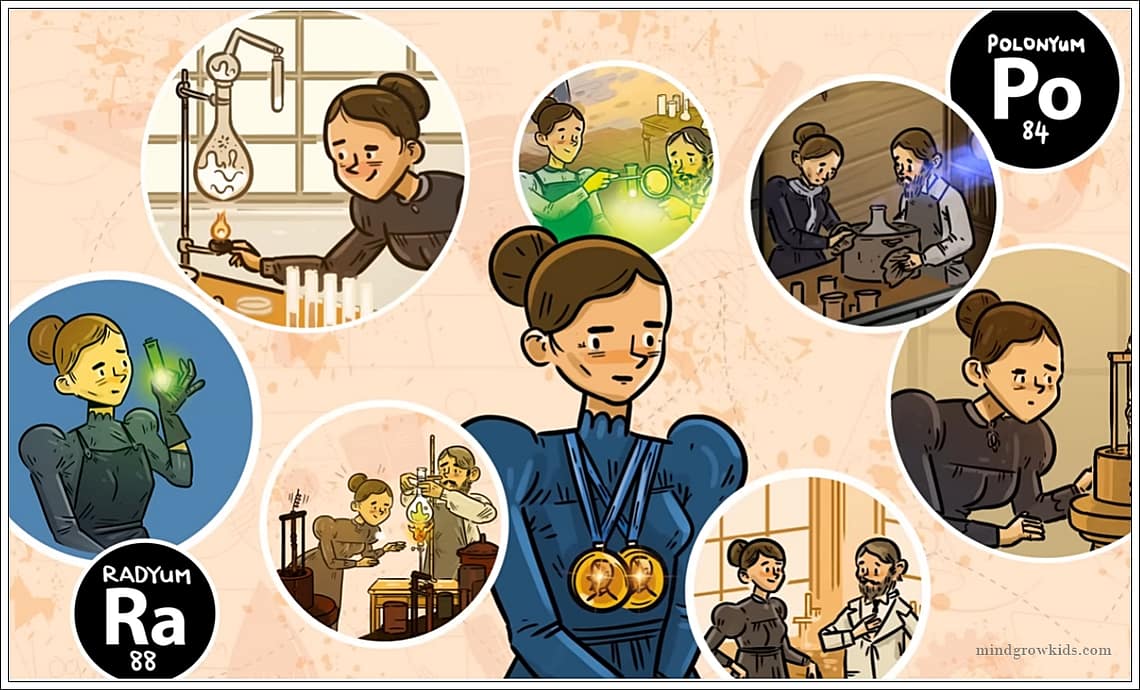
Marie Curie, the first scientist to win two Nobel Prizes – the 1903 Nobel Prize in Physics and the 1911 Nobel Prize in Chemistry – provides an inspiring life story for young people.
The history of modern science is illuminated by a few rare individuals whose determination completely altered human understanding. Among them, Marie Curie stands as a towering figure of resilience, brilliance, and selflessness. Born Maria Salomea Skłodowska on November 7, 1867, in Warsaw, Poland, her journey from a financially struggling household to the pinnacle of global science remains one of the most compelling narratives in human history.
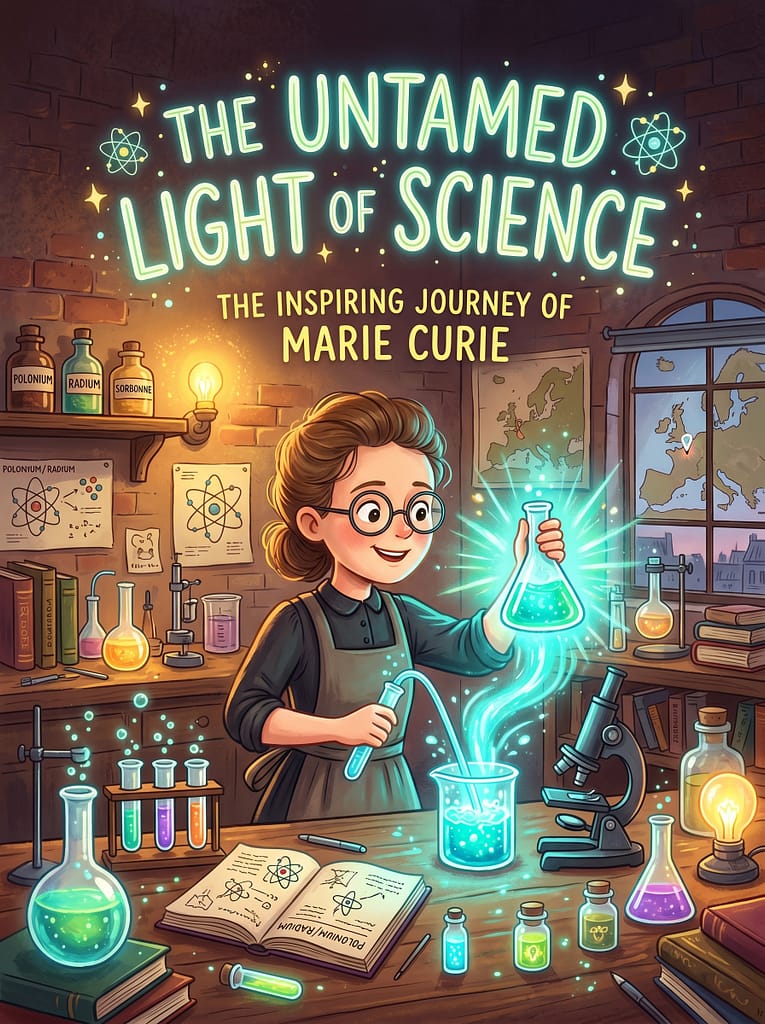
The Pursuit of Knowledge Against the Odds
Growing up in a politically oppressed Poland where women were legally barred from higher education, Marie’s academic ambitions faced severe systemic roadblocks. Her parents—a mathematics teacher and a school principal—valued education deeply but lacked the financial means to support her dreams.
Undeterred, Marie joined the “Flying University,” a clandestine, underground network of scholars who met in shifting, secret locations to evade the authorities. This precarious arrangement, however, was not enough for the education Marie envisioned. To secure a brighter future, she and her sister Bronya made a pact: Marie would work as a governess for five years to fund Bronya’s medical studies in Paris, and once established, Bronya would support Marie’s education.
This mutual sacrifice bore fruit in 1891 when Marie arrived in France to study mathematics and physics at the prestigious Sorbonne University. Living in poverty and surviving on minimal food, her relentless focus paid off, leading her to exceptional graduation results and a research position in an industrial chemistry and physics laboratory.
A Partnership of Minds and the Birth of Radioactivity
It was in Paris that Marie met Pierre Curie, a brilliant physicist and engineer who shared her deep devotion to science. The two formed an instant intellectual and emotional connection, marrying in 1895.
Looking for a groundbreaking topic for her doctoral thesis—a milestone no woman had yet achieved at a European university—Marie became fascinated by recent discoveries in physics. In 1895, Wilhelm Röntgen discovered X-rays, and shortly after, French physicist Henri Becquerel noticed that uranium emitted a mysterious, invisible energy capable of exposing photographic plates.
Marie decided to investigate these “Becquerel rays.” Using a highly sensitive electrometer developed by Pierre and his brother Jacques, she began meticulously measuring the electrical currents produced by different compounds. She discovered that the strength of the radiation depended solely on the amount of uranium present, unaffected by external factors like temperature or moisture. This led her to a revolutionary hypothesis: the radiation was not the result of a chemical reaction, but an intrinsic property of the atom itself.
To describe this phenomenon, Marie coined the term radioactivity.
The Discovery of Polonium and Radium
When Marie noticed that a uranium-rich mineral called pitchblende emitted radiation four times more powerful than pure uranium, she suspected the presence of an undiscovered element. Pierre recognized the profound implications of his wife’s work and abandoned his own research to join her.
Working out of a drafty, poorly ventilated shed, the Curies embarked on an agonizingly tedious process. They spent years manually processing, boiling, and filtering tons of raw pitchblende to isolate the mysterious elements.
In 1898, their patience was rewarded with the discovery of two new elements:
- Polonium: Named in honor of Marie’s beloved homeland, Poland.
- Radium: Named for its intense, luminous radioactivity.
By 1902, after processing eight tons of pitchblende, they managed to isolate just one-tenth of a gram of pure radium, revealing an element millions of times more radioactive than uranium.
Triumph and Tragedy
The scientific community could not ignore their monumental achievements. In 1903, Marie and Pierre were invited to the Royal Institution in London, making Marie the first woman to speak before the prestigious academy. That same year, Marie Curie, Pierre Curie, and Henri Becquerel were jointly awarded the Nobel Prize in Physics. With this, Marie became the first woman in history to win a Nobel Prize.
Tragedy struck in 1906 when Pierre was killed in a tragic street accident in Paris. Devastated by the loss of her partner, Marie channeled her grief into her work. She accepted the offer to take over Pierre’s chair at the Sorbonne, becoming the university’s first female professor.
Her continued brilliance led to a second historic milestone in 1911, when she was awarded the Nobel Prize in Chemistry for isolating pure radium and discovering polonium. To this day, she remains the only person to have won Nobel Prizes in two different scientific disciplines.
Science in the Service of Humanity
When World War I broke out in 1914, Marie Curie paused her research at her newly founded Radium Institute to aid the war effort. Realizing that battlefield doctors needed immediate diagnostic tools, she designed mobile radiography units—dubbed “Little Curies.”
Accompanied by her eldest daughter, Irène, Marie personally drove these vehicles to the front lines, training technicians and helping doctors locate shrapnel and fractures in wounded soldiers. After the war, she documented these experiences in her book, Radiology in War.
In her later years, Marie became a global icon, traveling to the United States to accept a gift of one gram of radium for her research, funded by a massive fundraising campaign led by American women.
A Lasting Legacy
Marie Curie’s lifelong, unprotected exposure to radiation eventually took its toll. On July 4, 1934, at the age of 66, she passed away from aplastic anemia.
Even after her passing, her family’s scientific legacy continued; in 1935, her daughter Irène and son-in-law Frédéric Joliot-Curie won the Nobel Prize in Chemistry for synthesizing new radioactive elements.
Marie and Pierre Curie famously refused to patent their extraction processes, choosing instead to share their knowledge freely with the world so that humanity could benefit from cancer treatments like radiotherapy. Marie Curie’s life stands as a testament to the idea that understanding the world is the ultimate remedy for fear. As she beautifully summarized her philosophy:
“Nothing in life is to be feared, it is only to be understood. Now is the time to understand more, so that we may fear less.”