

How does a grand piano work?

The grand piano isn’t just another musical instrument — it’s a masterpiece of mechanical engineering that has been sitting at the center of concert halls for over three centuries. At its core, it’s a string instrument, but one that gives the player the unique ability to bring out complex harmonies by pressing multiple keys at once. In this piece, we’re going to open up this iconic instrument and trace the intricate chain reaction that starts every single time a finger touches a key.
Opening the Vessel of Music
Walk into any concert hall, and the grand piano immediately stands out. Its shape is defined by that massive lid, which serves two purposes. When the piano isn’t being played, the lid stays closed to protect the delicate parts inside from dust. But during a performance, it gets propped open and angled toward the audience. And that’s not just for looks — the open lid acts like a megaphone, sending the instrument’s full, rich sound out toward the listeners while also giving them a peek at the mechanical dance happening inside.
Once you remove the music stand and the lid, the first thing that grabs your attention is the huge network of strings. They’re stretched tightly across a heavy cast-iron frame. On the right side, you’ll see short, thin strings that produce high-pitched notes. As you move left, the strings get noticeably longer and thicker to create deep, resonant bass tones. This variation in string length is exactly what gives the grand piano its distinctive curved shape.
The Lever and the Chain Reaction
A standard piano has 88 keys — 52 white and 36 black. To the person playing, they just feel like simple touchpoints, but each key is actually a long, hidden lever. When you press a key, you’re not just moving a piece of plastic or ivory — you’re triggering a sophisticated mechanism known as the piano action.
For most notes, a single hammer strikes three strings at the same time to create a full, bright sound. As the notes go lower and the strings get thicker, the hammer only hits two strings, and for the very lowest notes, just one. Because the bass strings are so thick and heavy, a single string gives more than enough volume.
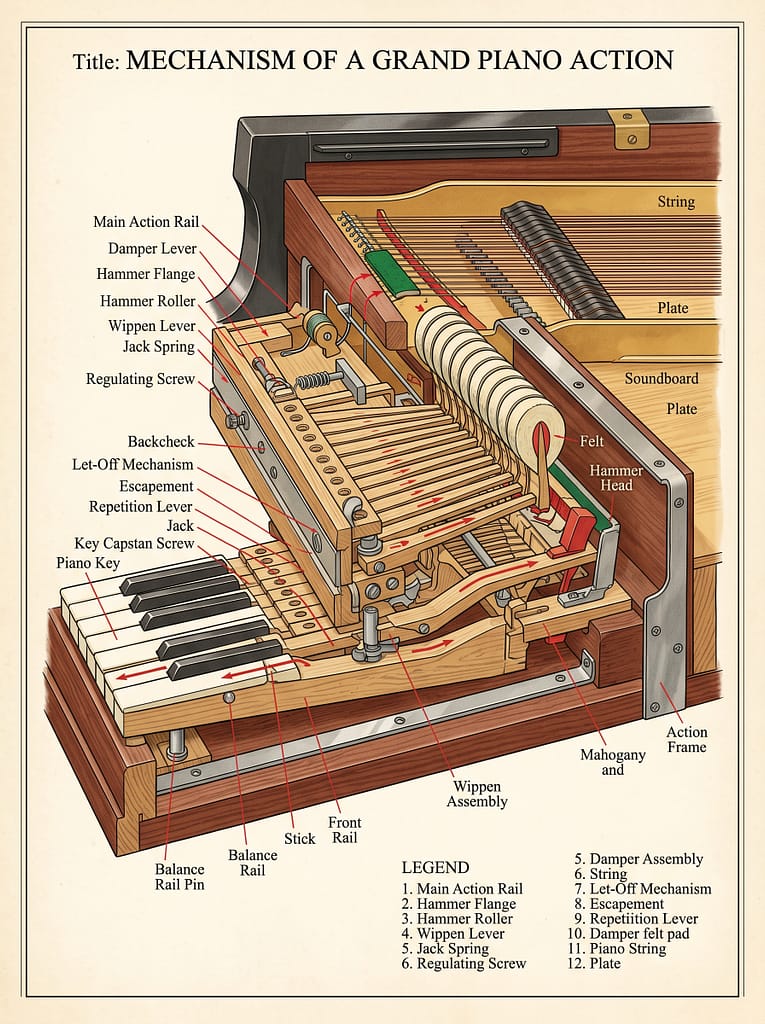
The Anatomy of a Keystroke
To understand how the sound is actually born, we need to look at the “whippen” — the heart of the internal assembly. Think of the key as a seesaw: when you press one end down, the other end lifts the whippen. That assembly is attached to a long bar running the length of the piano, which lets all the parts pivot with precision.
As the whippen rises, it engages a “repetition lever” and a small part called the “jack.” The jack passes through a hole in the repetition lever to give the hammer its final, decisive push toward the strings. This mechanism is incredibly sensitive: the harder you press the key, the faster the hammer hits, and the louder the sound. On the flip side, if you press the key extremely gently, the hammer might not even reach the strings at all — resulting in silence.
One of the most impressive features of the grand piano action is how quickly it resets itself. Thanks to the repetition lever, a pianist can strike the same note over and over again rapidly, without the hammer ever getting stuck or failing to reset.
Controlling the Vibration: The Dampers
While the hammers start the sound, the dampers control when it stops. Normally, these small felt pads rest firmly against the strings, keeping them silent. When you press a key, the damper lifts off, letting the string vibrate freely. The moment you release the key, the damper drops back onto the string, instantly stopping the vibration and silencing the note.
Interestingly, if you look at the very highest notes on the piano, you’ll notice they don’t have dampers at all. Those high-pitch strings are so short that their sound dies away almost instantly on its own, so a mechanical silencer just isn’t necessary.
A Prelude to the Pedals
Understanding how all 88 of these individual mechanical chains work together gives us a whole new appreciation for every note we hear. But the fingers only tell half the story. To truly get to the “soul” of the piano, you have to look down at the floor. In our next discussion, we’ll explore the three foot pedals and see how they control this vast mechanical forest to create sustain, softness, and depth.
In our previous discussion, we looked at what happens inside a grand piano the moment a single key is pressed. We saw the hammer, the damper, and the intricate chain reaction that turns a finger’s touch into sound. But that’s only half the story. The real expressive power of the piano lies just beneath it — in the three foot pedals. Let’s now explore what each pedal does and how it physically changes the instrument’s internal mechanism.
The Three Pedals at a Glance
Underneath any grand piano, you’ll find three pedals. Each one alters the sound in a different way:
- The left pedal is called the una corda pedal, more commonly known as the soft pedal.
- The middle pedal is the sostenuto pedal.
- The right pedal is the sustain pedal, also referred to as the damper pedal.
All three pedals work on a simple lever principle. When you push one down, the other side lifts up, moving rods that reach into the piano’s interior and affect the action mechanism in a specific way.
The Sustain (Damper) Pedal — Holding onto Sound
The sustain pedal is the one you’ll see used most often. When you press it, the sound continues even after you release the keys. Take your foot off the pedal, and the sound stops immediately.
To understand why, look up inside the piano. Remember the dampers from our first discussion? Those are the small felt pads that rest on the strings to keep them silent. Normally, when you press and release a single key, only that key’s damper lifts and then drops back down. But the sustain pedal changes that completely.
Inside, there’s a part called the damper lift rail. When you press the sustain pedal, a rod pushes this rail upward. The rail then lifts every single damper off all the strings at once. That’s why, even after you take your fingers off the keys, the strings keep vibrating and the sound continues. Release the pedal, and the rail drops back down, silencing everything.
The Sostenuto Pedal — Selective Sustaining
The sostenuto pedal works in a similar way to the sustain pedal, but with one crucial difference: it only keeps the dampers lifted for the keys that are being held down at the exact moment you press the pedal.
Let me explain. You press and hold a few keys. While holding them, you press the sostenuto pedal. Now, when you release those keys, their dampers stay up — so those notes keep sounding. But here’s the clever part: any key you press after pressing the pedal will behave normally; its damper will lift and then drop when you release it. The sostenuto pedal locks only the dampers that were already lifted at the moment of pressing.
Inside the mechanism, there’s a dedicated sostenuto rod running along the action. Each damper has a small felt tab sticking outward. When you press the pedal, a bar rotates into position. The dampers that are already lifted get caught on this bar when you release their keys, while all other dampers move freely.
The Soft (Una Corda) Pedal — Making the Sound Gentler
The soft pedal does exactly what its name suggests: it makes the entire piano sound quieter and more delicate. But how? It doesn’t muffle the strings like a piece of felt. Instead, it shifts the whole keyboard and action slightly to the right.
Normally, for most notes, a single hammer strikes three strings to produce a full, bright tone. When you press the soft pedal, a rod and lever mechanism moves the entire action assembly just a few millimeters to the right. As a result, the hammer now hits only two of the three strings. For the lowest notes, where there are already only one or two strings, the hammer strikes a less worn part of the string, creating a softer, more muted tone.
This mechanical shift changes both the volume and the timbre — the color of the sound — giving the pianist a beautifully gentle voice.
Bringing It All Together
The true magic of the piano happens when fingers and feet work together. A pianist might use the sustain pedal to create a wash of resonant chords, the sostenuto pedal to hold a single bass note while playing melody lines above it, and the soft pedal to whisper a quiet passage. Understanding how these 88 keys and three pedals physically interact with the strings and dampers gives you a whole new appreciation for every piece of music ever written for this remarkable instrument.
Source: https://www.youtube.com/watch?v=6effL4ATZVo